Introducing the Two Williams

Did you know that William Hamilton of The Woodlands and William Bartram of Bartram's Garden were contemporaries and friends? The two shared a love of plant collecting and botany, were neighbors, and were involved in many of the same local institutions! To highlight some of these lesser-known connections, we're bringing you Two Williams: a six month blog series hosted between The Woodlands and Bartram's Garden. Each month, we will dig into the archives and share what we find!

Picturing the banks of the tidal Schuylkill as a lush, pastoral landscape takes a bit of imagination these days. But long before it was home to manufacturing plants and oil refineries, the stretch of the River running through Philadelphia to the Delaware was considered one of the most beautiful scenic landscapes in the country.  Though much of this revered landscape was lost as the waterfront industrialized, some vestiges were spared. The Woodlands and Bartram’s Garden were both prominent 18th century estates and hubs for the early study of botany and horticulture, separated by just over a mile along the Lower Schuylkill. Safeguarded by early preservation efforts, both are now recognized as National Historic Landmarks, bastions of Philadelphia’s horticultural legacy that live on as parks, historic sites, and important community anchors in their respective neighborhoods.

The Woodlands and Bartram’s Garden shown on an 1808 map surveyed and published by John Hills. (Image: Philageohistory.org)

The Woodlands and Bartram’s Garden shown on an 1808 map surveyed and published by John Hills. (Image: Philageohistory.org)

The Woodlands and Bartram’s share a number of historical themes and connections, which we will be exploring in monthly blog posts. This month, we’ll begin by introducing two key players: William Bartram (1739-1823), son of John Bartram and William Hamilton of The Woodlands (1745-1813). The two men were friends and contemporaries (and, notably, both were both lifelong bachelors) passionate about botany and horticulture in distinct yet complimentary ways.

William Hamilton’s mansion as seen from across the river depicted by James Peller Malcom ca. 1792. (Image: Dietrich American Foundation)

William Hamilton’s mansion as seen from across the river depicted by James Peller Malcom ca. 1792. (Image: Dietrich American Foundation)

Portrait of William Bartram by Charles Wilson Peale, 1808 (Image: Independence National Historical Park)

Portrait of William Bartram by Charles Wilson Peale, 1808 (Image: Independence National Historical Park)

William Bartram, son of John Bartram (1699-1777), was a gifted naturalist and a very skilled botanical and ornithological artist. Growing up, he accompanied his father on many of his travels and gradually took over the maintenance of the family garden. Later, William spent the years 1773-1776 traveling the southern Colonies studying and collecting plants and animals. He interacted with local Native American tribes and made copious notes and drawings, writing extensively about his findings which were published as Bartram’s Travels in Philadelphia in 1791. Upon returning from his excursion in 1777, William resumed his work maintaining and caring for the family garden and business at Bartram’s with his younger brother John, Jr.

Portrait of William Hamilton and his niece Ann Hamilton Lyle. (Image: Historical Society of Pennsylvania)

Portrait of William Hamilton and his niece Ann Hamilton Lyle. (Image: Historical Society of Pennsylvania)

Just up the river, William Hamilton (grandson of prominent Philadelphia lawyer Andrew Hamilton, whose defense of John Peter Zenger established freedom of the press) established his estate, The Woodlands, in the style of an English country house. Hamilton inherited the estate from his father in 1747 when he was just two years old and had, over the course of his adult life, parceled together roughly 500 acres along the western bank, including much of what is now the campuses of Penn and Drexel. Hamilton was an Anglophile and an enthusiastic amateur botanist and plant collector. An extended visit to England in the mid-1780s inspired the neoclassical remodel of his Philadelphia estate, recognized as the earliest example of Federal architecture in the country, and heavily influenced his approach to landscape design. Thomas Jefferson, who was a frequent visitor to both Bartram’s Garden and The Woodlands, once remarked that Hamilton’s estate was “the only rival which I have known in America to what may be seen in England.” Hamilton was particularly interested in collecting rare and exotic plants, introducing a number of exotic species to the U.S. through his massive greenhouse complex which is believed to have housed upwards of 9,000 species.

The Woodlands and Bartram’s Garden formed the nexus of the country’s early botany scene and helped spur a regional horticultural economy that persisted for generations. Prominent naturalists, politicians, and members of the gentry would often stop at one or both gardens when travelling into the city. The two Williams frequently connected over their shared interest in plants and botany, often exchanging letters, plants, seeds and services. This relationship is best illustrated in their correspondence, which was frequent and familiar and often involved arranging the viewing, sharing, and trading of plant material.

A photograph of the Gingko at Bartram’s Garden from 1924 captioned “Oldest Gingko in America.” After William Hamilton imported the first Gingko biloba into the country, he kept two on his property at The Woodlands and sent the third as a gift to Wil…

A photograph of the Gingko at Bartram’s Garden from 1924 captioned “Oldest Gingko in America.” After William Hamilton imported the first Gingko biloba into the country, he kept two on his property at The Woodlands and sent the third as a gift to William Bartram. The two at The Woodlands no longer stand, but the impressive Gingko at Bartram’s still does and is recognized as the oldest living example in North America.  (Photo: John Bowman Bartram Special Collections Library)

In a letter[1] to William Bartram on November 7, 1796 Hamilton wrote:

Dear Sir

I must beg the favor of you to make a sketch of the Senecio nova, floribunda as it now blooms in my Hot House. For this obligation I will make you any compensation in my power. After this day it cannot be done this Season as its beauty is already on the decline.

I have moreover in my Hands at this moment, just arrived from England near 100 coloured plates mostly of new plants (some of them from Botany Bay) which you ought not to lose the opportunity of viewing & they are immediately to be return’d to the gentleman who left them here. I hope therefore you will oblige yourself as well as me by coming here as soon as you can after receiving this & that you will come prepared to make the sketch I have required, in which I am more interested for the Honor of American gardening than you are aware of. I have seen a figure & description of this plant as it flower’d last season for the first time in Europe, under the name of Senecio Chrysanthemum by which I find it flower’d with me before it was known in Europe.

                              I am dear Sir truly

                                             Your friend & humble Servt.

                                                                           W Hamilton


Both Williams also had connections to the University of Pennsylvania, then known as the College of Philadelphia, particularly to Dr. Benjamin Smith Barton, chair of Materia Medica and the sole professor of botany at the university. Bartram’s Garden and The Woodlands functioned as outdoor laboratories to supplement lectures and William Bartram often leant his services as a botanical illustrator to assist Barton. The relationship between the three ensured the university’s position as the best place in the country for the study of botany and both Hamilton and Bartram assisted in procuring and sharing noteworthy and interesting plant specimens. In the following letter, William Bartram writes Dr. Barton about the first blue hydrangea imported to America, on display at William Hamilton’s garden at the Woodlands:


P.S. Come see us as soon as convenient. Have you seen the most beautiful Hydrangia [sic] from china now in flower at Hamiltion’s Gardens at the Woodlands? if not it is well worth a visit. The Cœlestial  blue of the flowers is inexpressebly [sic] pleasing. [2]

An Illustration from Frank H. Taylor ca. 1922 showing the Woodlands mansion and John Bartram’s house as examples of country mansions from “a time when the unpolluted tide-water Schuylkill River was bordered by fine country seats.” (Image: Library Co…

An Illustration from Frank H. Taylor ca. 1922 showing the Woodlands mansion and John Bartram’s house as examples of country mansions from “a time when the unpolluted tide-water Schuylkill River was bordered by fine country seats.” (Image: Library Company of Philadelphia)

Hamilton frequently entertained guests at The Woodlands and his dinners and his gatherings, more often than not, involved lengthy discussions about plants and botany supplemented by demonstrations of species from his greenhouse. These were sometimes even coordinated around significant bloom times of his most impressive rare species, which would be brought in to the house to be observed and appreciated throughout the meal. In the following letter,[3] Hamilton requests a sample of a particular variety of grape from Bartram to serve the dual purpose of botany and dessert at an upcoming dinner:


My dear Sir

Mr Pursh tells me that he was at your house yesterday & that you shewed him a white grape which you called Blands grape—From what I have heard you say, I have always supposed it a dark fruit & my curiosity is exited to understand the Business. I will therefore thank you to send me a specimen of the fruit by the bearer. If it is ripe & you can spare them, you will oblige me by sending as many as will fill a plate as if the fruit good, it would serve as an interesting part of our Desert [sic] at dinner to day for Mr. & Mrs. Merry whom I expect will be here—

                                                                                          —I am most sincerely

                                                                                                         Your friend

                                                                                                                        W. H.

Stay tuned as we highlight more of the fascinating botanical connections between these two sites!

Upcoming Posts: 
Found in the Floorboards: 200 Year Old Seed Packets
William Bartram's Travels and the Early Naturalist's Library
Think Local Swap Global: 18th Century Approaches to Plant Collecting
From Seed Shack to Plant Palace: Evolutions in Greenhouse Technologies
The 19th Century Commercial Nursery

By Starr Herr-Cardillo


[1] William Hamilton to William Bartram, November 7, 1796, Gray Herbarium Autographs 3:17a, Harvard University.

[2] William Bartram to Benjamin Smith Barton, July 16, 1800, Barton Delafield Collection, American Philosophical Society.

[3] William Hamilton to William Bartram, circa 1803-1805, Bartram Papers 4:49b, Historical Society of Pennsylvania.


This blog series is made possible by Penn Sustainability and PennDesign. 

The Woodlands Wins 2018-2019 Barra Award

 
WoodlandsLogo2.jpg
BarraLogo_highres_dropshadow_official.jpg

The Woodlands Wins 2018-2019 Barra Award for Exemplary Nonprofits in the Greater Philadelphia Region  

December 5, 2017 – Wayne, PA — The Barra Foundation has announced that The Woodlands is a recipient of a 2018-2019 Barra Award. The Woodlands joins 43 exceptional nonprofit organizations in the Greater Philadelphia region that will each receive $50,000 in grant funding. Barra Awardees are nominated by their peers in the social sector and are then invited to submit an application to the Foundation. The application questions focus on the organization’s leadership, performance and adaptability.  

"It is an honor to be part of this exemplary list of awardees. The unrestricted funding that the Barra Award provides will allow us to continue to grow and serve our community better than ever."

                                                                                                    - Jessica Baumert, Executive Director

In line with the Foundation’s mission to invest in innovation in the social sector, the Barra Awards provide unrestricted funding and introduce awardees to a diverse network of social sector leaders. “Without unrestricted capital, nonprofits have little margin for error or appetite for innovation. Through the Barra Awards we hope to provide organizations with some financial breathing room and their leaders with opportunities to learn from their peers—a diverse and inspiring network of entrepreneurial thinkers from across the nonprofit sector,” said Kristina Wahl, president of The Barra Foundation.

Since its 2013 inception, the Barra Awards has granted more than $6 million to area nonprofits. Awardees represent a range of nonprofits from the Arts and Culture, Education, and Health and Human Services sectors in the Greater Philadelphia region.  

A full list of the 2018-2019 Barra Award winners is available here.

To learn more about the Barra Awards program, click here.

About The Barra Foundation: The Barra Foundation invests in innovation to inspire change that strengthens communities in the Greater Philadelphia region. Through its Catalyst Fund and Barra Awards, the Foundation provides approximately $4 million in annual grants that are focused on supporting innovation in and across the fields of Arts & Culture, Education, Health and Human Services. 

About The Woodlands: The Woodlands’ 54-acre undulating landscape is at once a one-of-a-kind 18th-century English pleasure garden, 19th-century rural cemetery, and a modern green oasis for its neighbors in bustling University City and West Philadelphia. The Woodlands was designated a National Historic Landmark District in recognition of its unique history and rich resources. Actively used today, the cemetery, mansion, landscape, and programs are an educational resource for local school children, community residents, university students, as well as for a small, highly motivated cadre of scholars seeking further understanding of American architectural and botanical history, urban development, and the origin and growth of West Philadelphia.

Today, our mission is to enrich the lives of area residents and visitors by serving as a hub for activities and educational programs that interpret, celebrate and make available to the public The Woodlands’ historic buildings and tranquil green space.


### 

UCD-Drone_Online-BARRA.png

Toribird's Tips on Birding the Woodlands

FullSizeRender (12).jpg

I have loved birds since I was five years old!  I am now fourteen  and an intern for the Woodlands.  

My talking parakeet gave me the nickname “Toribird”. Coincidentally, ‘Tori’ means ‘bird’ in Japanese! 

In addition to The Woodlands, I also volunteer at a bird-banding station. I found a rare Black-headed Gull at John Heinz NWR, own a parakeet, and have participated in birding competitions. However, I'm not a total bird-brain. I am a nature photographer,  pianist, and beginner singer. I enjoy writing stories that combine birds and music - my two passions.

Some notes on seasonal birding at the Woodlands:       

Spring: Watch for migrating warblers, thrushes, and other songbirds.  Swallows will arrive. 

Summer: A rather dull time to bird. Look for breeding songbirds, and hummingbirds.   

Fall: Look up! Migrating hawks, warblers, and nighthawks make Fall a fun season for birding.                  

Winter: Small songbirds such as sparrows and kinglets are fun to see.  It is easy to see birds since the trees are leafless. 


Sept. 27, 2017   Northern Rough-winged Swallows are plentiful at the Woodlands! However, they will soon migrate south, so catch them while you can. It is fun to watch these acrobats zip through the air as they chase insects. 

The swallows are similar to the Chimney Swift, but swifts are gray, have shorter tails, and generally fly higher. Swifts will also soon fly south. But, when the acrobatic insectivores are gone, it will be time to watch for ducks, kinglets, and sparrows.

Northern Rough-winged Swallow photo by Toribird

Northern Rough-winged Swallow photo by Toribird

Oct. 4, 2017  Hawks are awe-inspiring creatures.  When they soar, they appear to be made of sun and wind. The great news is that hawks are easily seen at the Woodlands! The Woodlands are home to two hawk species: the Red-tailed Hawk and the Cooper's Hawk.  The Cooper’s is seen in the forested area near the VA, and the Red-tail is seen in more open areas, generally near the house. 

So how do you tell them apart? See the guide below.

Red-tailed Hawk: Overall chunky build. White belly, dark brown back, and rust-red tail. Band across the belly made of brown spots. 

Cooper's Hawk: Overall slender build. Gray back and orange-tan belly. Thin black-and-white stripes on tail.


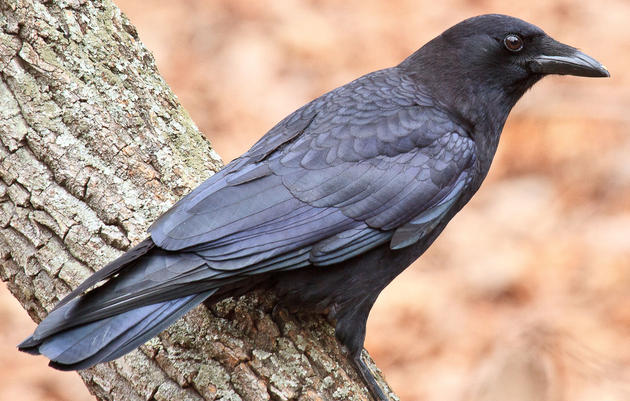
Oct. 11, 2017 If I say CROWS, what comes to mind? Do you think of spooky Halloween decorations, or a swarm of black birds, or a crow picking at bones?

Though crows have a bad, scary reputation in our culture, they are actually fascinating birds! Crows, magpies, and jays make up the Corvid family. Corvids are some of the smartest birds, capable of making tools, solving multi-step puzzles, and recognizing individual faces! 

The American Crow is common in Philadelphia, and can certainly be seen at the Woodlands!


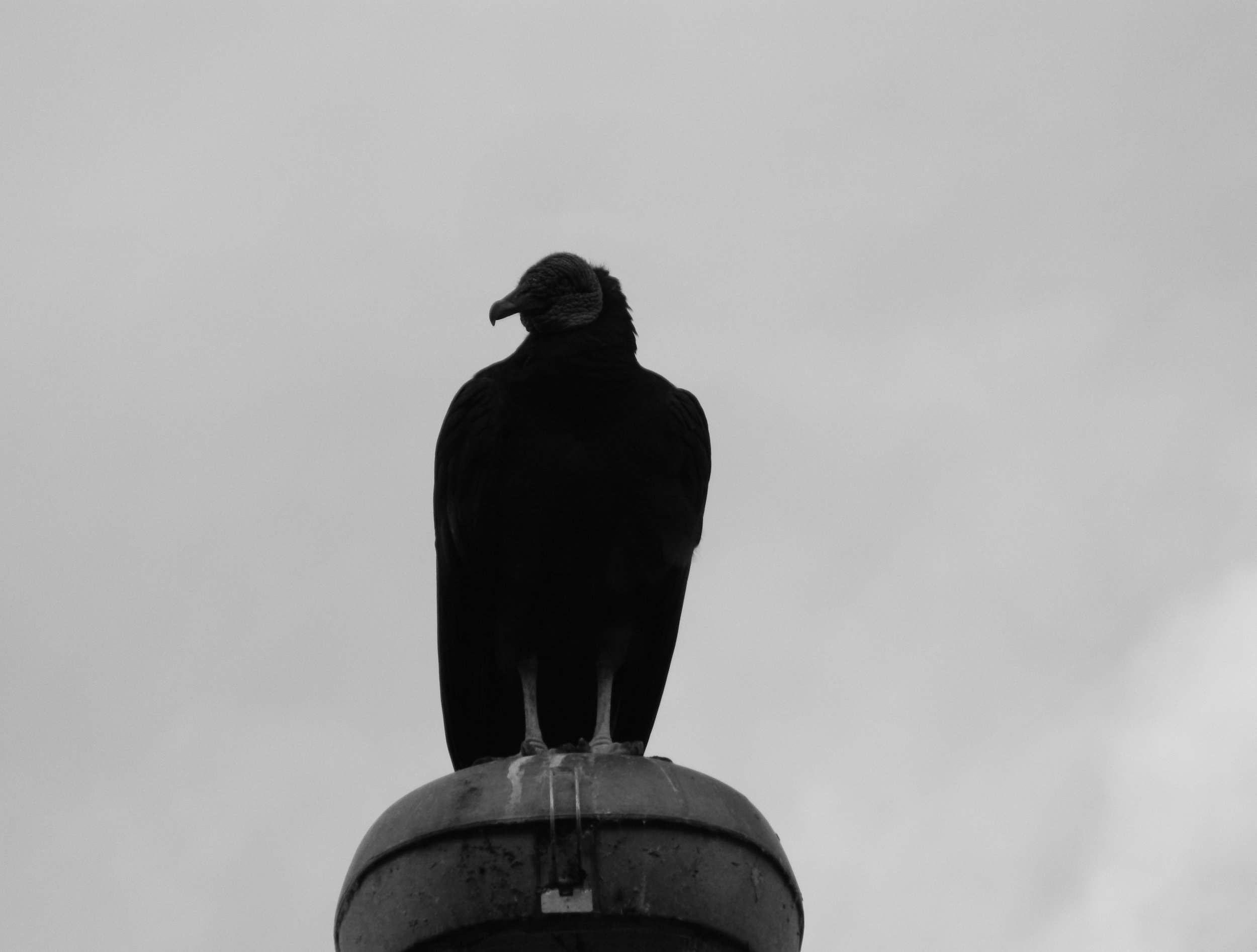
Oct. 18, 2017 If I had to guess, I'd say you didn't like vultures. You might even be afraid of them. However, they are interesting, useful, lovable birds. 

Contrary to some myths, vultures do not predict death. Since they eat animals that are already dead, they almost never kill. And if they did not clean up carrion, there would be dead, rotting animals everywhere!

Also, though their heads are rather ugly, vultures' plumage is sleek and elegant. The Black Vulture is especially striking with its all-black body and silvery-white wingtips. Wildlife rehabbers and zookeepers have even described vultures as sweet and shy. It's no wonder vultures are my favorite birds! 

Black Vulture photo by Toribird

Black Vulture photo by Toribird

Nov. 1, 2017 As the seasons change, some birds migrate south and others arrive. One of these new arrivals is the Yellow-rumped Warbler. These birds are a bit smaller than sparrows. They are overall brown with darker stripes and yellow patches at the base their of tail (rump; hence their name), head, and flanks. You will likely see them in a Juniper (evergreen) tree, eating the berries. These adorable birds are common, and can make birding even more fun! 


Nov. 8, 2017 Have you ever heard the term 'Invasive Species'? If you're not familiar with this term, an invasive species is an animal, plant, or other organism that has been introduced to a part of the world where it did not originally occur. 

There are many invasive birds in the United States. Three of the most common are Rock Doves (pigeons), House Sparrows, and European Starlings. Due to that fact that invasive birds are typically quite common, they are a good group for beginner birders to learn. 

Unfortunately, since invasive species are adaptable and numerous, they often out-compete native birds. For example, European Starlings are pushing Purple Martins, a bird native to the US, out of the martins' former nest sites.  

European Starling photo by Toribird

European Starling photo by Toribird

Nov. 15, 2017 Tap. Tap-tap. Tap-tap-ta-trrrrrr. A woodpecker drumming on a tree may be a familiar sound for you. Woodpeckers, as a group, are common, and adapt easily to living near humans. You may have even had a woodpecker drum an your house! 

The woodpecker group consists of birds that have woodpecker, sapsucker, or flicker in their names. For example, the Downy Woodpecker, Yellow-bellied Sapsucker and Northern Flicker are all types of woodpeckers (and they all can be seen in Philly!).

The Red-bellied Woodpecker has one of the worst names in the history of ornithology! Not only does its "red belly" consist of only a faint pink tint, it also has a far more obvious red stripe going from its forehead to its nape. This can cause confusion with the similarly-named but overall different-looking Red-headed Woodpecker. 

If you want to attract a woodpecker to your front yard, try putting up a suet feeder. Suet and the feeder can be found at most pet and grocery stores.


Nov. 30, 2017 As the nights get longer and the wind colder, people may think that winter is a bad time for birdwatching. It is true that some birds leave the Mid-atlantic to spend the season farther south. However, there are many that summer in northern places like Canada, and spend the winter right here in Philly!

Ducks, kinglets, and sparrows are among those that winter in this area. Also, birds like the Blue Jay, American Robin, and Red-tailed Hawk, along with various types of woodpeckers, can be seen year-round at The Woodlands. 

Finally, since most trees have lost their leaves, it is much easier to find all these winter treasures!


Dec. 13, 2017 If you hear the word 'robin', you probably think of spring, blossoms, and April showers. However, contrary to popular belief, robins can be seen in Philly year-round! 

Robins are a good bird for beginner birders to learn as they are distinctive, common, and, as mentioned above, can be seen all year. The distinctive markings of robins consist of a brick-red breast, gray back, yellow bill, and a broken white ring around the eye. See if you can spot these markings on the picture below! 

The robin's full common name is American Robin, and its scientific name is Turdus migratorius.

American Robin photo by Toribird

American Robin photo by Toribird


Jan. 3rd, 2018  Though you might not think it, gulls are not seen only at the ocean. Ring-billed Gulls are a common year-round Philly resident. They are often seen on the Schuylkill and Delaware Rivers, lakes, and even shopping center parking lots! The Schuylkill River can be seen from the Woodlands, especially in winter. Try to spot a gull next time you visit! 

To know what to look for, see the Ring-bill photo below. 

Ring-billed Gull photo by Toribird

Ring-billed Gull photo by Toribird

Jan. 24, 2018 With the Super Bowl coming up, everyone is talking about the Eagles. What better way to celebrate your team's victory than seeing a wild Bald Eagle? See the list below for good places to see our national bird and the mascot of Philly's football team. 

  • The Woodlands: Bald Eagles have been seen at the Woodlands, though they are not as common as some other birds. Since they eat fish, they are usually seen flying over the Schuylkill River. They can be seen year-round.

  • Conowingo Dam (Maryland): There is a guarantee of seeing eagles here - if you go in the winter. The eagles love to hunt the stunned fish that come through the dam.

  • John Heinz at Tinicum: There is a resident, breeding pair of Bald Eagles here that can be seen year-round.


Feb. 28, 2018 Spring is just around the corner, and the weather seems to agree! For birding, this means spring migration! Two main groups of birds that pass through Philly is spring are warblers and shorebirds.

WARBLERS: small, often colorful insect-eating birds. Learning songs is helpful for identifying warblers high up in leafy trees. Yellow-rumped Warblers are winter birds for Philly, but most others pass though in spring and fall.

SHOREBIRDS: small to medium long-legged birds. They are often gray or brown, but cute despite dull color. They can be seen at the beach, on the shores of ponds, and on mudflats along rivers. Some stay year-round, but most migrate. 


March 14, 2018 So you're watching a movie set in Alaska's wilderness. A Bald Eagle soars overhead, and you hear its majestic scream - "Kreeaa-kaa!" 

Except... that's not really the sound that eagles make. The stereotypical hawk or eagle sound is the cry of the Red-tailed Hawk. This sound is used in place of the true eagle call for a good reason - Bald Eagles sound like hoarse chickens. To hear a recording of an eagle, click here: https://www.xeno-canto.org/explore?query=Bald+Eagle


April 11, 2018 Spring migration is a wonderful whirlwind of color, sound, and diversity. Many birds can only be seen in Philly during the spring and fall - they spend the summer farther north, like in Canada, and the winter farther south, in Florida or the Bahamas. One of these birds is the Blackpoll Warbler. 

Blackpolls are known for their amazing flight from boreal forest in Alaska and Canada to South America. Some birds fly nonstop over the ocean! The blackpoll is not alone, however. Thrushes, orioles, and swifts also make incredible yearly journeys. Some shorebirds even make it to Argentina! 

If you've been considering going on a birdwalk, now is the time! This display comes only once a year, so grab it while you can!


May 1, 2018 With the warmer weather comes a feathered cornucopia of color and activity! Let's take a closer look at the bird species and bird activity that we can expect to see in the next few weeks.

First of all, spring migration is nearing its peak! This means that many birds such as warblers, thrushes, and shorebirds are passing through Philly on their way to more northern regions. Also, birds like swallows and the Chimney Swift, to name a few, will return to breed right here. 

Also, year-round residents like sparrows, finches, and woodpeckers are beginning to build nests. If you see a bird carrying grass, twine, or something similar, rest assured that it is busy constructing a safe home for its babies. 

So head to the Woodlands, and see what springtime activity you can spot! 

Tree Swallow photo by Toribird

Tree Swallow photo by Toribird