The Woodlands Gobble Wobble: An adventure in urban running and wild turkeys.

Toribird here, to remind you that along with hot cider, first frosts, and colorful trees, another fall tradition not to be missed is the Woodlands Gobble Wobble 5k this Saturday November 3rd at 10:00AM! Come run to support your favorite urban cemetery while enjoying the scenic and historic grounds! Register in advance, or on race day starting at 9:00AM.

“Gobble Wobble” is a cute name because of the tradition of eating turkey on Thanksgiving, but did you know that  Wild Turkeys have been seen right here at the Woodlands, in addition to many other places in Philly?

Wild Turkeys are native to North America, and rather widespread. They usually like to hang out in fields near forest edges or in laws with several trees. They seem to be happy to live near people, though they also inhabit very rural areas. Unlike their domestic relatives, Wild Turkeys can fly. They usually prefer to walk, however, flying up to trees only to roost at night. 

The Woodlands is not the most reliable place for turkeys, though they have been spotted here a few times in past years. If you're just not having any luck, however, try Bartrams Garden, another urban jewel.

Wild Turkey photo by Toribird

Wild Turkey photo by Toribird

Birding at The Woodlands: You Never Know What You'll See!

This is especially true as right now is prime time for migration! All kinds of birds, from eagles to songbirds, are crossing continents, some by day, some by night. Some make shorter journeys, not leaving the country, yet others will travel all the way to Argentina! Some birds, like the Northern Rough-winged Swallow will leave the Northeast for now, and others, like the White-throated Sparrow will join us for the winter.

This same Red-tailed Hawk is shown in the video later in the blog. Photo taken at the Woodlands by Toribird.

This same Red-tailed Hawk is shown in the video later in the blog. Photo taken at the Woodlands by Toribird.

Many warblers are currently on the move. However, they can be a real challenge to identify in the fall as almost all have changed from their bright spring colors to drab, olive-green plumage with significantly less variation between species. However, two warblers that are still easy to recognize are the Black-throated Blue and Black-and-White Warblers. These little birds are passing through Philly on their way South. Both are conveniently well-described by their names: the male Black-throated Blue Warbler has a steely-blue back, a black throat and mask, and white underparts.  Black-and-White Warblers are simply striped black and white. They like to act like little woodpeckers, crawling vertically on trees. 

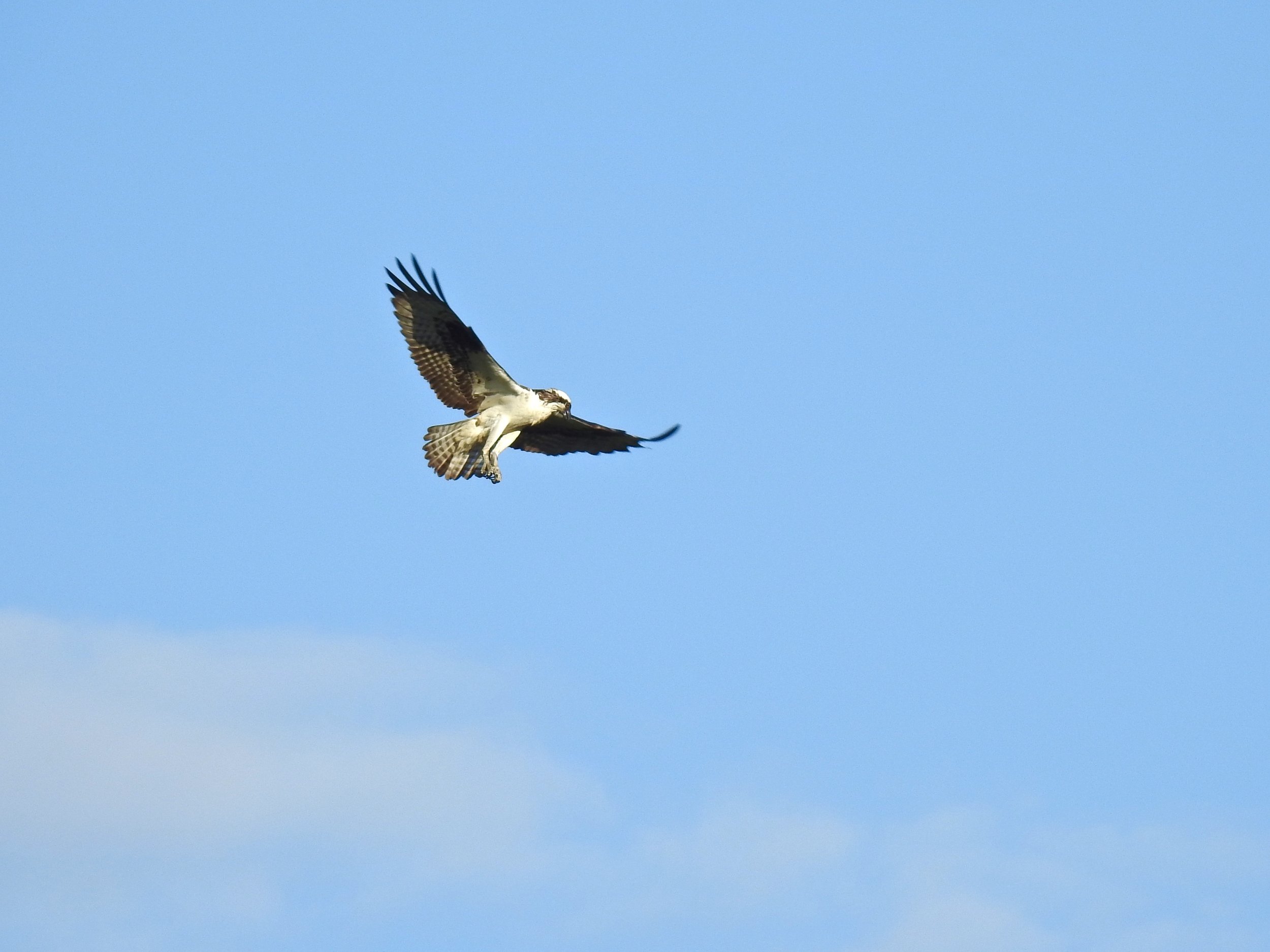
An Osprey striking a pose for the camera. Photo by Toribird.

An Osprey striking a pose for the camera. Photo by Toribird.

Many species of birds of prey are also traveling right now. Keep your eyes to the sky, as many will be flyovers, just trying to cover distance and not hunting or landing. You could see Bald Eagles and Ospreys, or falcons like American Kestrels and Merlins. Many hawks like the Sharp-shinned Hawk and Red-shouldered Hawk will also be passing through. Keep in mind, though, that most will be in flight, and sometimes distant or backlit. Test your ID skills on these migrants, but don't fret if you can't always pin down a species. Sometimes, they are best left as the ever-common Black Dot in the Sky Bird.

Speaking of hawks, check out this video of a Red-tailed Hawk, a common bird in Philly, eating a chipmunk at the Woodlands! 

I caught the resident cemetery Red-tail eating a light dinner of a chipmunk in September 2018.

Interested in coming on one of my (Toribird’s) bird walks? I will be leading two on Sunday, October 21 as part of Halloween Family Fun Day. They are geared for beginner birders, but all skill levels are always welcome! We can expect to see birds like flickers, starlings, robins, and House Finches, among others. If you’ve wanted to try birding the Woodlands but have been a bit hesitant, a guided walk could be a good way to start. 

Written by Toribird

The Haseltine Family: Modern Art Moguls

Surrounded by lovely, lily-gilded stone lies Elizabeth Holmes Haseltine under the impersonal moniker "Mother." Born in Pittsburgh in 1842 to attorney and businessman Joseph and his wife Esther Holmes Hoge, Elizabeth was also the granddaughter on both sides of two Presbyterian preachers. In 1863 in Pittsburgh, she married Philadelphia-born Charles Haseltine, the scion of an old New England family and the brother of artist William Stanley Haseltine. He was a merchant who left the University of Pennsylvania after two years to start his professional life. Charles' interests are better documented than his wife's; like many upper class men of his day, he was a member of the Philadelphia Sketch Club, the Union League, and the Art Club. He was the owner of the international art house, Haseltine Art Galleries, and was known as a prominent international art dealer. Haseltine handled some of Thomas Eakins' early works, including "The Gross Clinic" and "The Agnew Clinic" which were first exhibited at Haseltine Art Galleries.

The Haseltine Gallery used to stand at 1416-18 Chestnut Street.

The Haseltine Gallery used to stand at 1416-18 Chestnut Street.

Haseltine_Gallery_Interior.jpg

The couple had three daughters and lived comfortably at 1707 Spruce Street with domestic servants. The middle daughter Elizabeth, "Lillie," died at age 14 and is buried to the left of her mother in the Haseltine plot. Elizabeth died in March 1891 at age 50 of acute laryngitis at a resort in Coronado Beach, CA where she visited the Pacific Ocean for the first time with her husband. It is likely that they stayed at the Hotel del Coronado as the "Del" was completed in 1888. (The Del's founders built the seaside resort in what was a barren landscape to market luxury resort vacations to the Gilded Age bourgeoisie.) The funeral took place in April in Philadelphia at the Second (now First, after a 1949 merger) Presbyterian Church at Walnut and 21st Street, a Henry Augustus Sims design from 1872.


Grave Gardens in the Haseltine Family Plot.

Grave Gardens in the Haseltine Family Plot.

Written by Amy Lambert, current Grave Gardener of Elizabeth Haseltine. "I'm honored to design and grow a tribute garden to dear Elizabeth." The Haseltines are buried in Section L - 44


Birding at The Woodlands: Breeding Season and the Promise of Migration

In the last episode of Birding at the Woodlands, we saw that breeding season was fast approaching. We can now see the offspring of the birds who were working so hard to build a nest and care for their babies! Though out of the nest, these fledglings  are not independent. You can often find them begging for food by chirping and fluttering their wings. Even though there are many older babies already out and about, there are many songbird families with younger birds still in the nest. Also, plenty of birds have more than one clutch (a group of eggs) each year, so there will be fledglings to see all summer! 

So, let's have a look at how to tell young songbirds from their parents, since seeing cute, fuzzy babies is one of the best parts of summer birding!

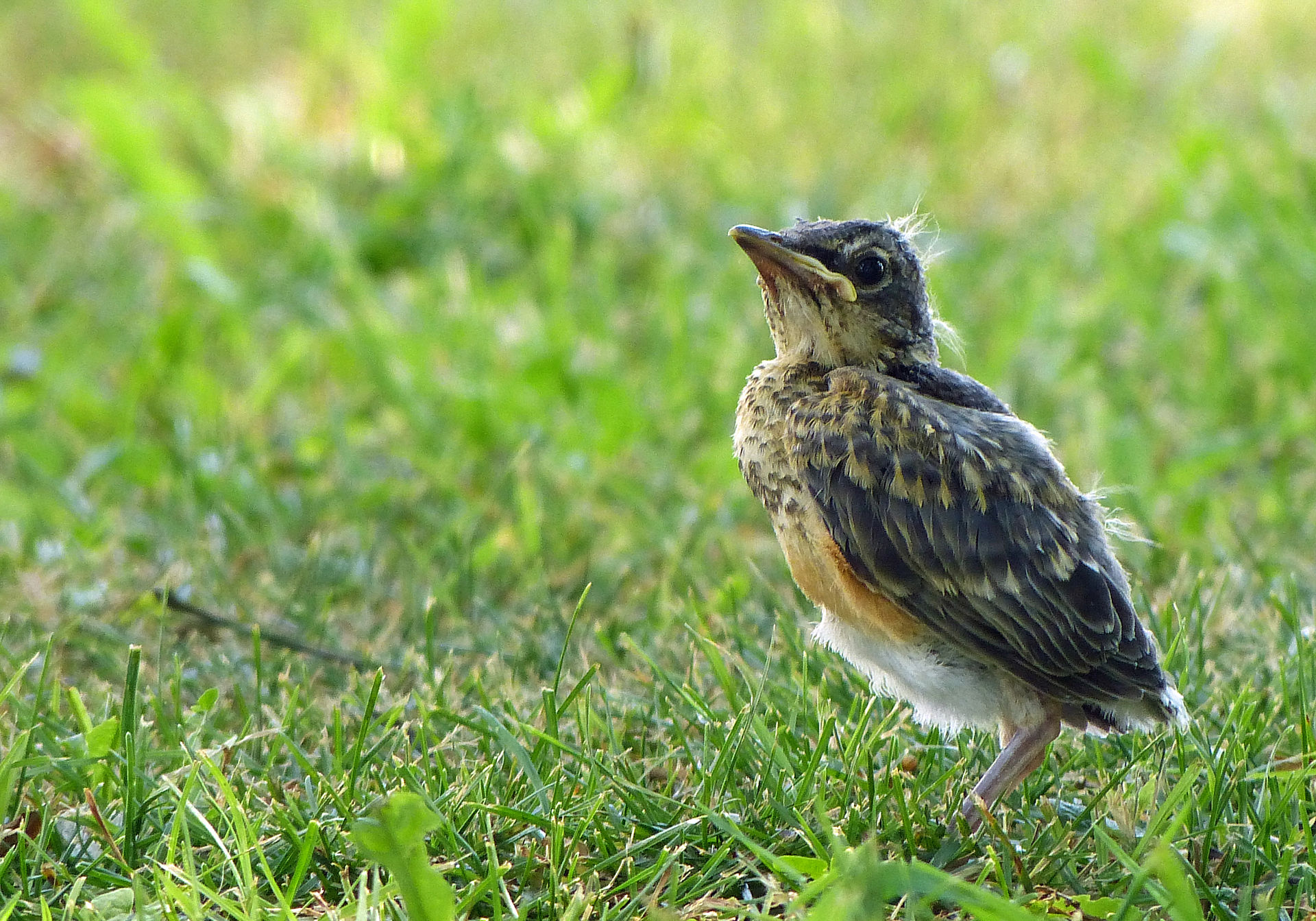
Photo from Wikipedia Commons by M.L. Haen

Photo from Wikipedia Commons by M.L. Haen

There are two main ways to identify a young bird, such as the robin pictured above: the beak and the tail (remember it as the two extremities - beak and tail). Baby songbirds have soft, yellow flaps of skin in the corner of their beak, sometimes called "bird lips". Also, they have very stubby tails, as their feathers are still growing in. There are other ways to tell, like stubby wings and left-over fuzz, but the extremities are the easiest to spot. 

Summer is not the most popular time to go birding, likely because birds are in 'stealth mode' so that predators can't find their nests or babies. Additionally, birds have already paired up, so there is no need to sing for a mate. It also just seems like birds don't care for heat!

Northern Rough-winged Swallow, a summer resident of The Woodlands. Photo by Toribird.

Northern Rough-winged Swallow, a summer resident of The Woodlands. Photo by Toribird.

Despite this, and in addition to seeing cute babies, migration is not far off! Shorebirds are one of the first migrant groups, beginning to travel around mid-August, but warblers, hawks, and others will soon follow. Migration is always an exiting part of the birding year, so definitely check out some local birding spots in the next month. While shorebirds are rarely seen from The Woodlands, due to our lack of, well, shore, they are easy to see on the mudflats of John Heinz, a wildlife refuge near the Philadelphia Airport. Also, the Woodlands is a great place for warblers, and you should be able to catch a migrating hawk or two as well. 


Written by Toribird