Birding at the Woodlands: Celebrating Summer Before it's Over!

I hope you've had a great summer, and got to experience some breeding season bird drama! Speaking of breeding, some types of birds have a unique juvenile plumage that allows us to easily recognize this year's babies. The young birds typically are the same size and shape as the adults, just with different colors. A couple common birds with distinctive juvenile plumage are the American Robin and European Starling. Young robins are paler than the adults, with speckles on the back and chest. They may also have pale markings on the face. European Starlings hatched this summer are a dusty brown with a black bill. They stand out as being paler than the adults and lacking iridescence. You may also see starlings with a 'patchwork' of brown and glossy dark feathers as the young molt into their adult colors.

Starling in juvenile plumage, picture by Toribird

Starling in juvenile plumage, picture by Toribird

Adult starling, picture by Toribird

Adult starling, picture by Toribird

Keeping with the theme of baby birds, we saw something interesting on a Woodlands birdwalk a couple weeks ago - a young Brown-headed Cowbird that was being fed and tended by a parent Chipping Sparrow. Yes, that's right - the cowbird was being raised by a different species. Believe it or not, this is actually quite typical! Brown-headed Cowbirds are brood parasites, which means that the females do not tend their young at all, but rather lay their eggs in other birds' nests. Because cowbirds are large compared to birds like the Chipping Sparrow, this can result in comical scenes of a parent feeding a baby that is much larger than they are!

To stay in the summer mood, let's talk about the ocean! I will be going to the Jersey shore this weekend, but I'm not going to stay at the beach. I'll be boarding a boat that will take me (and several others) far out to sea for a birding trip called a pelagic. It may surprise you, but there are many birds that live offshore, and can't really be seen from land. Albatrosses are probably the most famous birds with this lifestyle. Many of the species that I hope to see belong to a group referred to as the 'tubenoses'. To learn more about this group, click here. They get the name from tube-shaped structures that sit on their beak which house a salt gland allowing the seagoing wanderers to drink salt water - the excess salt is excreted and drips down the beak. Birds are fascinating!

Written by Toribird

Birding at the Woodlands: Warblers, Waxwings, Breeding Season, and More!

This is the 1-year Anniversary of Toribird’s blog series, and she’s kicking off summer with a great blog post.


Male Yellow Warbler, photo by Toribird

Male Yellow Warbler, photo by Toribird

Though spring migration is all but over, there is still lots to see! Most warblers pass through Philly only on migration, but some breed right in the area, staying the whole summer! A couple of these charming residents are the colorful Yellow Warbler and the striking Black-and-White Warbler. Both are common in forested areas like The Woodlands, and their appearance is summed up by their names: Yellow Warblers are all yellow, with rusty streaks on the male's belly. Black-and-Whites have long stripes of black and white. Listen for the Black-and-White's song as you bird - it sounds a lot like a squeaky wheel.

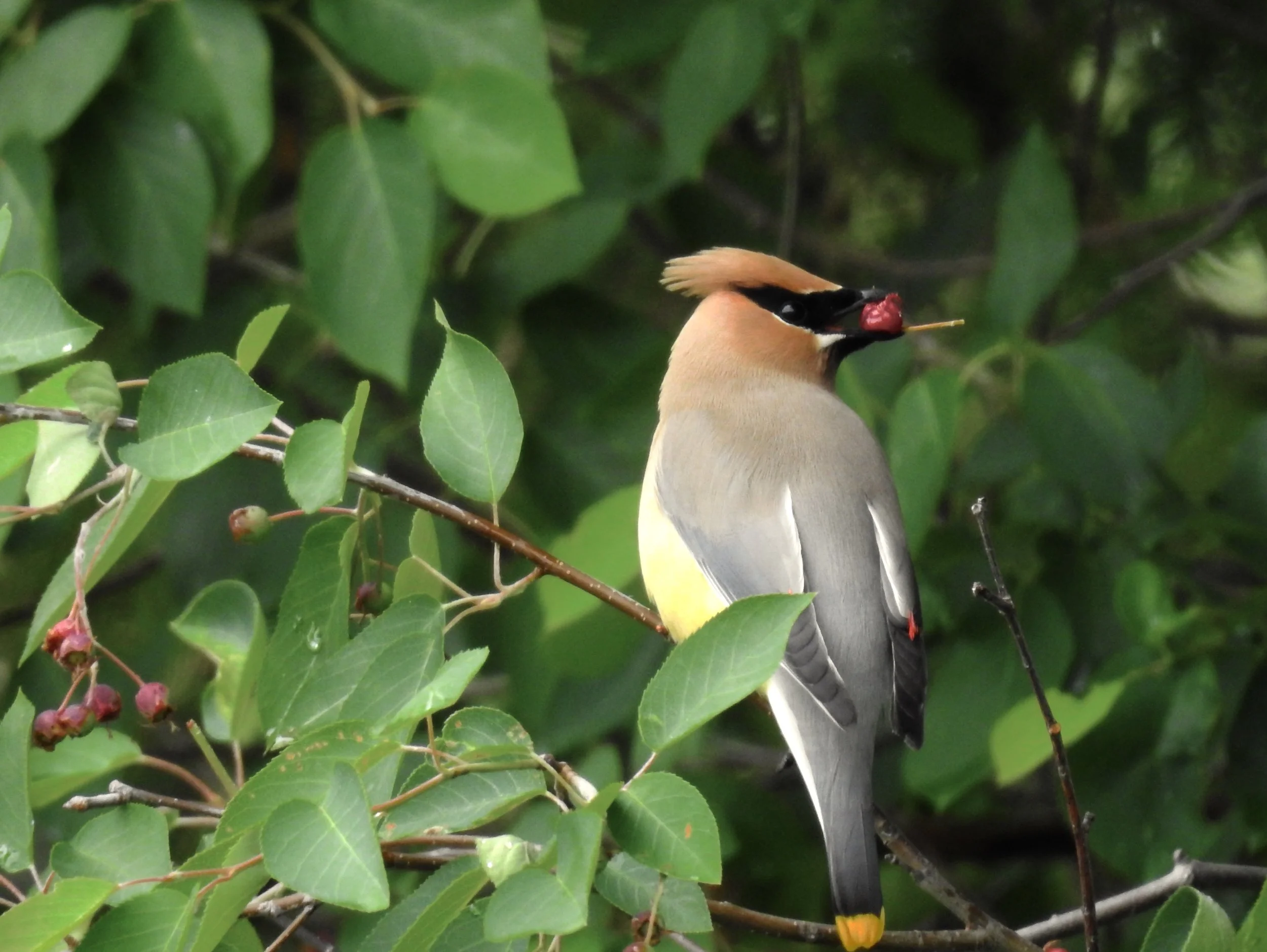
In addition to the warblers, another exciting bird in the area is the Cedar Waxwing. These attractive birds get their name from red drops on their wings that resemble sealing wax. They are nomadic with irregular movements, and it seems like a fair bit of them are in the area right now! A good clue to their presence is their very high-pitched, squeaky, whistles or trills. They are very gregarious, meaning that they like to be in a flock with others. So, if you see a waxwing, look around - there are probably lots more nearby! 

Cedar Waxwing enjoying berries, photo by Toribird

Cedar Waxwing enjoying berries, photo by Toribird

Another bird to keep your eye out for is the Mississippi Kite. While rare this far north, there has been a relatively high amount of them around in the past month. If you see one, it will probably be flying overhead. Kites' pointed wings, darker wingtips, smooth gray underparts, and graceful flight can point you towards an ID. Keep checking the sky while you bird - you might catch a kite! 

Kite 2017 1.jpg
Mississippi Kites in New Jersey, photos by Toribird

Mississippi Kites in New Jersey, photos by Toribird

And now, let's talk about what Summer might be best known for - it's breeding season! Lots of songbirds are building nests and feeding hungry babies. Some already have fledged, are are hopping around, stubby-winged and fuzzy, exploring the world beyond their nest. You may have heard that a baby bird will be ignored by its parents if touched by a human - this is not true. While birds are very well taken care of by attentive parents, and there is usually no need for us to interfere, if a baby is in immediate danger (e.g. being stalked by a cat or in the middle of the street) it doesn't hurt to move it to safety.

Written by: Toribird

For more information about Toribird and her birding tips, check out this past blog post.

Celebrating Dr. Neville Strumpf

neville-strumpf2.jpg

On May 20th, 2019, someone very special to The Woodlands is receiving an Honorary Degree from the University of Pennsylvania!

Dr. Neville Strumpf, one of our board members, will be attending the University of Pennsylvania’s 263rd Commencement ceremony in order to receive her Honorary Degree, which is awarded to only those that represent the highest ideals of the Ivy League school, so I guess you could say this is a pretty big deal. Other people being honored on this day are animal scientist Temple Grandin and singer-songwriter Jon Bon Jovi.

Neville has contributed immensely to the nursing community. After receiving her Bachelor’s from the State University of New York and her master’s at Russell Sage University, Neville decided that she wanted to continue her education even more by receiving her PhD at New York University in 1982.

After her academic success, Neville dedicated her time to researching geriatric nursing, or nursing for elderly patients, trying to implement more ethical treatments into her field. Dozens of her publications ultimately led to more effective, ethical methods to care for geriatric patients.

unnamed.jpg

Neville didn’t stop at the research, though! In the 1980s, Neville helped found several geriatric nursing programs at the University of Pennsylvania to improve the care of older adults. She made an appearance on C-SPAN (1:22:00) representing the National League of Nursing at a Senate Finance Subcommittee on Health meeting to discuss the nursing shortage in 1987. She used her experience to highlight the lack of nurses who were trained to care for the elderly at this time. Her work was crucial to the expansion of Geriatric Nursing in this country.

From 2000-2001, Neville became Interim Dean of the Penn Nursing program. During her time as the Dean, she put her staff and students first to ensure they had the right resources and funding to support research projects and help programs reach their goals. Neville’s service to the nursing field has expanded the way people think about geriatric nursing to aid patients with the best care possible. Read about her work in her book, Restraint-Free Care online.

Neville’s late life partner, Karen Buhler-Wilkerson, worked alongside her in improving the education and research at Penn Nursing. Karen worked as a professor of community health at Penn and also served on the board of The Woodlands. Karen passed away in 2010 and we are honoring her memory as we celebrate Neville’s accomplishments that she supported throughout her life. The Nursing Center remembers Karen’s notable accomplishments, and how she "...helped found Penn Nursing's Living Independently For Elders (LIFE) program, which provides ongoing daily care for 500 poor and frail residents of West Philadelphia." She is buried at The Woodlands and her legacy can be felt at The Woodlands and in the greater Philadelphia community.

Through her work, Neville has exhibited a true dedication to geriatric nursing and patients globally, and has shown that same dedication in other parts of her life. As if all the work she has done wasn’t enough, she is the president of the board at the Ralston Center, a non-profit that focuses on assisting people 55 and older with services to equip them for independent living in their homes and communities. Her work at the Ralston Center revolves around spreading her knowledge of gerontology to others as a respectful leader. Neville truly believes in running a non-profit like a family, utilizing her past experiences to help others become leadership ready. She is also on the advisory board of Barbara Bates Center for the Study of the History of Nursing, and, of course, one of our very own board members here at the Woodlands.

Neville has shown an outstanding amount of work and service not only in her field, but in her community. Her honorary degree is extremely well-deserved and we thank Neville for all she has done for The Woodlands. Shout out and HUGE congrats to you, Neville! You rock!

Written by: Alyssa Geniza

Birding at The Woodlands: Enjoying Early Spring

Our resident birding expert, Toribird, weighs in on the joys of springtime birding:

Right now is a great time to go birding! Okay, I know I say that in every blog post, but at this time of year there are many things in the birder's favor:

Currently there is a fascinating overlap between the winter birds and the arriving warm weather residents. Many birds have begun to sing to attract a mate or defend territory, and will continue to for a while, so now is a great time to learn their songs, as every species has a unique one. (Or just listen to their serenades for pleasure!) Most trees have not fully leafed out yet, so now is your last chance to see birds without the obstruction of foliage.

Dark-eyed Juncos (Snowbirds) are still around, but will fly back north soon. Picture by Toribird.

Dark-eyed Juncos (Snowbirds) are still around, but will fly back north soon. Picture by Toribird.

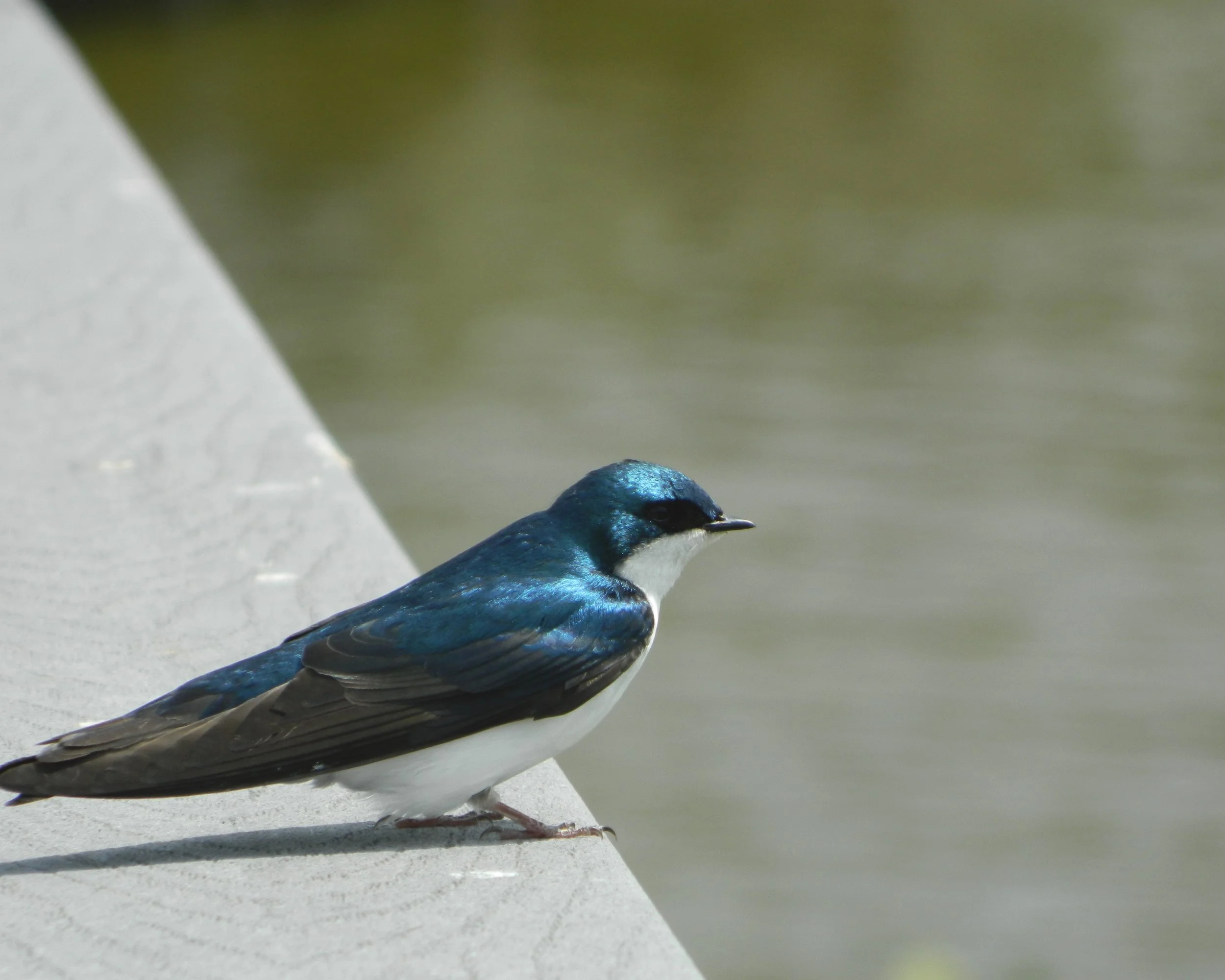
This shimmering Tree Swallow is one of the newer arrivals. Picture by Toribird.

This shimmering Tree Swallow is one of the newer arrivals. Picture by Toribird.

As I was birding at The Woodlands on April 11th, I saw a lot of Ruby-crowed Kinglets. The adorable, active, tiny birds are named for a red patch on their head, most obvious when the birds are agitated. Kinglets are a winter bird in Philadelphia, and will head back to their summer homes in a few weeks. Check out The Woodlands and catch them while you can!

Cute Ruby-crowned Kinglet. Picture by Toribird.

Cute Ruby-crowned Kinglet. Picture by Toribird.

Conversely, I have also seen Northern Rough-winged and Tree Swallows, which arrived not too long ago. These insect-eaters need bugs like mosquitos and gnats, which, being cold-blooded, are not around in the winter, causing the birds to migrate. Ospreys are also back, and Chimney Swifts and warblers should not be far behind, along with all the other warm-weather residents!


For more seasonal bird trivia, let's talk about the Barnacle Goose! This is not a recent arrival, nor is it a winter bird that will soon leave. In fact, it is very rare to see one in the area at all! It is a bird that, during the Middle Ages, was enjoyed during Lent, when practicing Christians forgo eating meat. Historically, it was believed that Barnacle Geese “popped out” from seed pods on plants or from barnacles on driftwood. Therefore, many people argued that it should be considered a plant instead of an animal. The practice of eating Barnacles Geese during Lent ended when Pope Innocent III officially declared the geese as birds. If you want to read more about this legend, check out the Canterbury Cathedral website.

A depiction of Barnacle Geese 'sprouting'. Copyright David Badke; http://bestiary.ca.

A depiction of Barnacle Geese 'sprouting'. Copyright David Badke; http://bestiary.ca.


Finally, to end on an artistic note, I've included a poem that I wrote just a few days ago. I was inspired by the natural springtime beauty that I encountered while going about my daily activities in the heart of Philadelphia.

Nature’s Springtime Bliss in Philadelphia Streets

Look at the cherry tree on your street.
Do you see it’s blossoms, pale and sweet?
The bumblebees come, the bumblebees go,
Pollinating the blooms as they do so.


If the petals have fallen off your tree,
Observe its leaves, a pretty light green.
Beyond the tree, looking way up high,
Lovely clouds float in the light blue sky.


Oh, the warm breeze that flies by you,
It feels so good, so free and true.
Suddenly, you see an Osprey high in the air
Perhaps returning home right then and there.


Dandelions, violets, forsythias bloom,
Threads of color on nature’s loom.
Even invasives are welcome today;
On the starling’s back the sunbeams play.


Hear the robins and cardinals sing,
Hear their lovely melodies ring.
Looking at all this, do you not feel
The joy of a mountain spring, right now, right here?

Written by Toribird
April, 2019

Birding at The Woodlands: Get to Know - and Help - Philly's Feathered Friends with Toribird

If you are a Philadelphia local, you may take pride in the knowledge that you live somewhere that has been a city since before the United States existed. That's awesome culturally and historically, but at the same time you may find yourself asking, is this sprawling city bare of birds and other animal life? No, surprisingly not at all! Quite the opposite.

The city of Philadelphia is a good place for birding, with lots of green space from your tiny neighborhood square to Fairmount Park. Even building-covered streets with small yards can be surprisingly diverse. During migration, warblers can pop up in any tree. Hawks, vultures and eagles can be seen flying overhead all year. The Schuylkill and Delaware rivers are good for herons, swallows, gulls and ducks. Common birds like robins and cardinals serenade us on spring mornings - if you wake up early enough. 

Mixed flock of gulls on the Delaware River. Photo by Toribird.

Mixed flock of gulls on the Delaware River. Photo by Toribird.

Unfortunately, cities are also full of deadly dangers for all these urban residents. Many are hit by cars, and outdoor cats kill or injure countless birds. One of the leading causes of bird deaths in North America is window collision. Birds either see habitat through a window or reflected in it, and fly into the glass trying to get to that habitat. Birds are quite intelligent, and would perhaps learn to avoid glass if they got the chance, but a bird's first encounter with glass is almost always their last. Somewhat surprisingly, most of these collisions aren't with glass-covered skyscrapers, but with the windows of America's residential homes because more individual homes exist than skyscrapers. There are, however, many easy ways to keep your house from killing birds. Check out these websites for detailed information: 

https://abcbirds.org/get-involved/bird-smart-glass/ 

https://www.allaboutbirds.org/why-birds-hit-windows-and-how-you-can-help-prevent-it/

Below are five species of birds that are more common and easy to see in Philadelphia than you may think.  

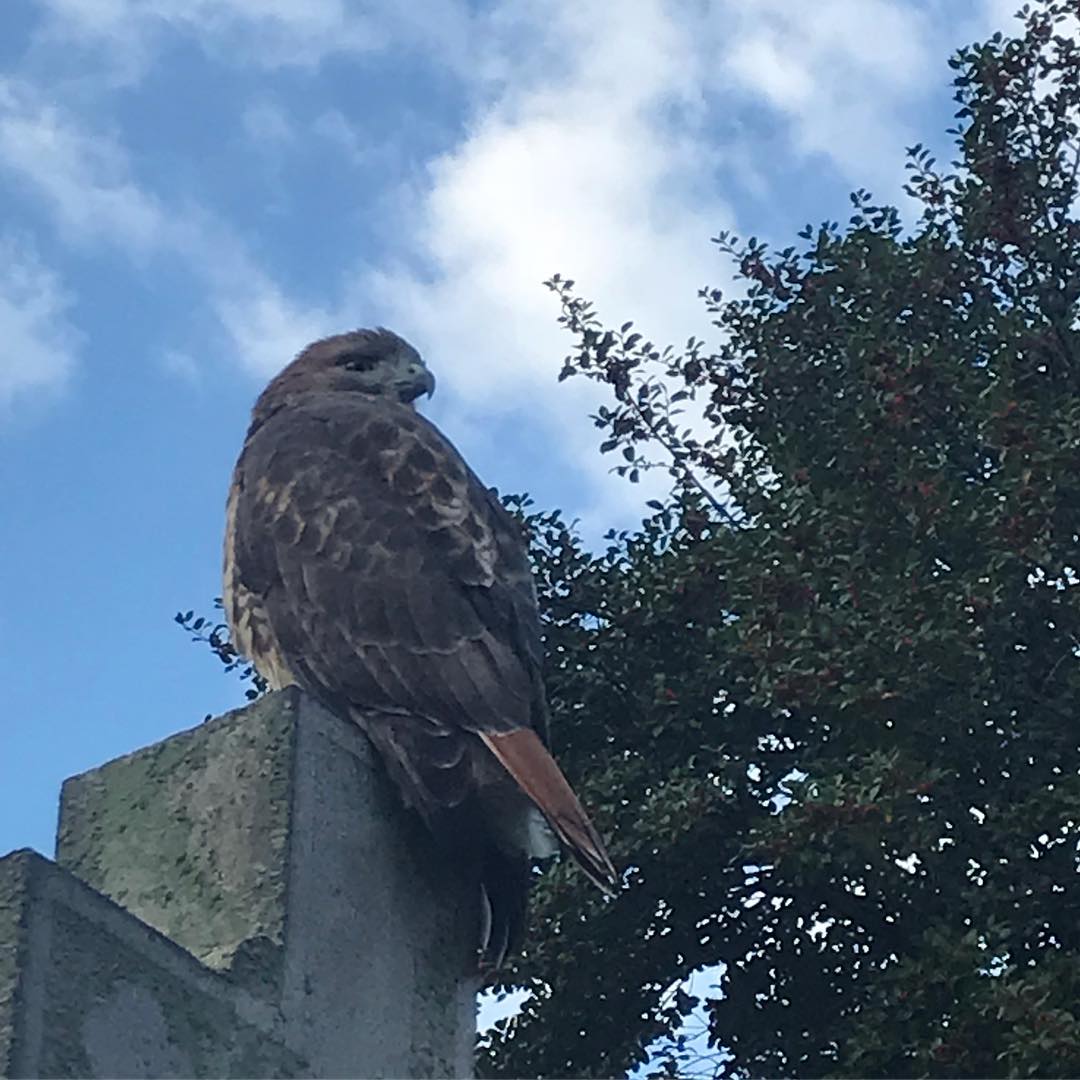
1. Red-tailed Hawk - This large, sturdy raptor is well adapted to living in both rural and urban areas. The adults do have a rusty-red tail, particularly obvious when the birds are circling above, but young birds have brown-and-black striped tails. Philly hotspot for this bird - The Woodlands

Red-tailed Hawk at The Woodlands.

Red-tailed Hawk at The Woodlands.

Red-tailed Hawk on Washington Ave. Photo by Toribird.

Red-tailed Hawk on Washington Ave. Photo by Toribird.

2. Bald Eagle - Our national bird has made a big comeback after being severely impacted by DDT. Bald Eagles eat fish, so they often hang out near water. Philly hotspot for this bird - John Heinz NWR at Tinicum

3. Double-crested Cormorant - These strange, duck-like birds catch fish by diving underwater. They have no waterproofing oils on their feathers like many other birds do, so they often perch on a log or other structure with their wings spread out to dry. Philly hotspot for this bird - Art Museum on the Schuylkill  

4. Wild Turkey - Contrary to what you may think, these birds can fly. Like most other game-birds, though, turkeys have powerful legs and usually prefer to walk, flying up into trees to roost at night. Philly hotspot for this bird - Bartram's Garden

5. Ring-necked Duck - These black-and-white eraserheads are a superb example of a badly-named bird. Their 'ring-neck' consists of a very faint chestnut-brown collar, visible when the birds are in-hand, a reminder that shotguns - not binoculars - were once the birder's tool of choice. Philly hotspot for this bird - FDR Park

Colorful American Robin in a West Philly backyard. Photo by Toribird.

Colorful American Robin in a West Philly backyard. Photo by Toribird.

So, now that you've read about all this urban diversity, head outside as the weather turns toward spring and see what kinds of feathered Philadelphia residents you meet! 

Written by Toribird