

The Woodlands has entered into a new agreement with [UCD’s] subsidiary Green City Works (GCW) for landscaping services at the historic cemetery. Located at 4000 Woodland Avenue in University City, the Woodlands encompasses 54 acres of undulating landscape that has served as an 18th-century English pleasure garden, a 19th-century rural cemetery, and a modern green oasis and escape for neighbors and explorers. The partnership with Green City Works will involve care and maintenance by a crew made up of West Philadelphia residents who are graduates of UCD’s West Philadelphia Skills Initiative.
Read More
Introducing Leontyne Watts
Many people are familiar with the Harlem Renaissance, the vibrant period of Black arts and culture coursing through the streets of Harlem, NY in the mid 20th century. It may surprise you to learn however, that a prominent member was born and raised right here in West Philadelphia, and was buried here at The Woodlands Cemetery in 2019. Her story is remembered by many, but not very well known. With the help of her family and the Blockson Library at Temple University, we’re able to share her story with you.
Read More
Congratulations, Philly, on joining Lights Out! Photo by Toribird.
Great news for Philly's Migrant Birds!
It's Toribird here, bringing great news for Philadelphia's birds and bird lovers! Philly has finally joined over 30 other cities in a Lights Out program to give migrant birds safer passage. Many major Center City skyscrapers have voluntarily agreed to turn off all outside lights during peak migration seasons.
Read More
William Hamilton's Roses
William Hamilton was famous for his voracious plant collecting, and was passionate about rare plants. His greenhouse at The Woodlands held over 10,000 plant specimens and was one of the most important horticultural sites in the country in the 18th century. In celebration of Valentine’s Day Weekend, we are sharing the story of how the first red roses were introduced to America by our own William Hamilton at The Woodlands.
In November, 1785 William Hamilton wrote to his private secretary in Philadelphia of the “red monthly rose” and in February, 1788 he wrote again of “the two or three cuttings of the china rose, which I planted in pots.” The rose Hamilton was referring to was known commonly as ‘Slater’s Crimson China’ and was one of the first four “stud roses” to come from China.
Before the last decades of the 18th century, the only roses with which Westerners were familiar were fragrant, pink flowered, coarse shrubs that bloomed once a year in late spring. These flowers were popular but were mostly admired for their medicinal value. The arrival of the China roses created both excitement and lust among European and American gardeners. The flowers of the China rose themselves were small and scentless, borne on twiggy, somewhat shapeless plants. What was revolutionary about these roses was the color of the flowers, which opened true red, yellow, and blush, depending on the variety.

Roses planted by a Grave Gardener in the Jayne Family Plot at The Woodlands.
Pictured here is a red China rose planted in one of two grave gardens in the Jayne Family Plot in Section D, not far from the Hamilton Mansion. Dr. David Jayne was a 19th century doctor who operated a pharmacy in Philadelphia and exported medicines worldwide. The rose planted here represents both the history and value of early roses, and the new possibilities the China Red Rose offered the gardening world.
Hamilton was one of the first-if not the very first- persons in America to acquire the China rose. There would be no red roses in your Valentine bouquet if not for the introduction of China rose, and for the accomplishments over the next two centuries of many horticultural careers devoted to its hybridization. Crossed with the old European varieties, it is the ancestor of nearly all the modern roses we love today.

Jane Austen Promenade. Bath, England.
Promenades and English Gardens
On a surprisingly sunny day for England in September 2019, over 500 people in Regency style dress strolled from Sydney Garden through the streets of Bath, led by the 33rd Regiment of Foot, red-coat reenactment soldiers and the town crier. This was the world-famous and record-breaking event known as the Grand Regency Costumed Promenade, the official opening to the annual Jane Austen Festival in the beautiful Georgian city of Bath, England. The Promenade is the largest of all festival events and is a nod to the social and cultural phenomenon that was walking in public during the Regency era. Jane Austen also used the act of walking as a tool in character and plot development in her novels. After all, many important plot elements are revealed during walks in the country or by the sea in Persuasion and Mr. Knightly often opts for country walks instead of using his carriage in Emma.
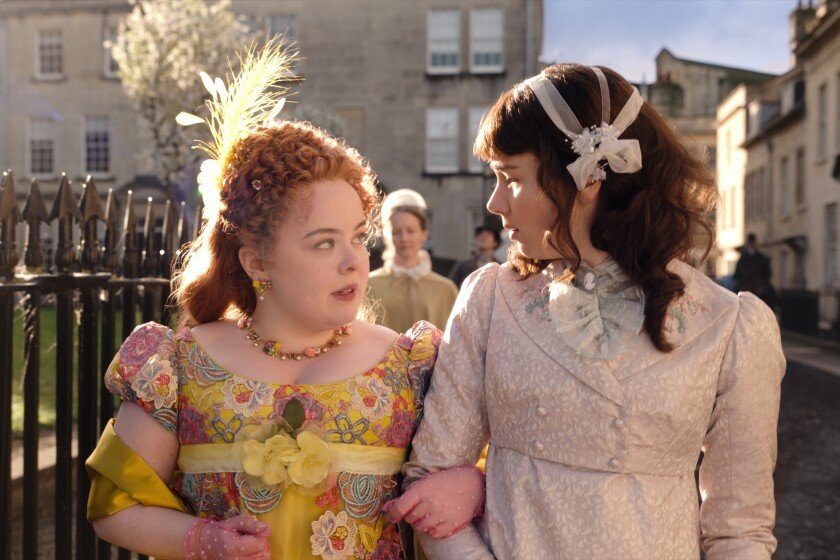
Walking for exercise, fashion, and as a social event was an important part of Regency life, especially those of the upper class privileged to using promenading and strolling as a recreational event to see and be seen. For the ladies and gentlemen of the upper class, walks were never undertaken as a means of travel (they had a carriage for that), but rather for enjoyment and display through public places. Women especially took advantage of these public social outings as an opportunity to publicly promenade with other stylish people in the latest fashions. Walking or promenade dresses featured unique design details and were subject to their own fast-changing trends in color and fabrics. Adorning your hair with feathers and ribbon was also popular, and it’s easy to make your own Jane Austen style headband at home.

William Groombridge, The Woodlands, the Seat of William Hamilton, Esq., 1793, oil on canvas, 45 5/8 x 58 1/8 in. (115.8 x 147.6 cm). Santa Barbara Museum of Art, Gift of Mrs. Sterling Morton for the Preston Morton Collection.
Those especially fortunate to promenade often walked in the delightful and picturesque paths of English landscape gardens like Stowe in Buckinghamshire, and Stourhead in and Wiltshire. Also known more simply as the “English garden,” landscapes such as Stowe and Stourhead are examples of the style that emerged in England in the18th century as the predominant gardening style of Europe. Much more informal than previous styles of symmetry and order, these gardens drew inspiration from idealized pastoral landscapes and idyllic paintings, often with groves of trees, paths to reveal specific views, and interspersed examples of classical architecture. Sound familiar? This is the world William Hamilton was accustomed to and the aesthetic theories that greatly influenced the building and landscape design of The Woodlands.*
![James Peller Malcolm, The Woodlands From the Bridge at Gray’s Ferry, c. 1792–94, in Beth C. Wees and Medill H. Harvey, Early American Silver in the Metropolitan Museum of Art (2013), 259. [2]](https://images.squarespace-cdn.com/content/v1/51ad165be4b095d664d87dfe/1612537225780-CU0JT92BL96F2UL3RSQS/Hamilton_Mansion.jpg)
James Peller Malcolm, The Woodlands From the Bridge at Gray’s Ferry, c. 1792–94, in Beth C. Wees and Medill H. Harvey, Early American Silver in the Metropolitan Museum of Art (2013), 259. [2]
Hamilton entertained guests at The Woodlands during the Philadelphia social season, like many Philadelphians with similar means and prestige. It is quite exciting to think of visitors promenading around the site and experiencing the winding paths and surprising vistas in the garden of the mansion overlooking the Schuylkill River. In a letter from L.G. to her sister Eliza after a visit to The Woodlands in 1788 she describes a walk with Hamilton around the landscape:
“Mr. Hamilton was remarkably polite - he took us round his walks which are planted on each side with the most beautiful & curious flowers & shrubs they are in some parts enclosed with the Lombardy poplar except here & there openings are left to give you a view of some fine trees or beautiful prospect beyond...when you arrive at the bottom of the lawn along the borders of the river you find quite a natural walk which takes the form of the grounds entirely shaded with trees...
It would take several days to be perfectly acquainted with the various beauties of this charming place."[1]
This year, we are bringing the tradition of promenading and strolling through English gardens and the spirit of Austen’s writing to the Woodlands with the first ever Jane Austen Promenade on February 13, 2021 from 3:00-5:00PM! In celebration of the things that make The Woodland’s landscape so special (and to give us a reason to step away from our screens and enjoy the simple pleasures of the outdoors!) we invite you to promenade with us. You can learn more about the event here.
* Did you know: The reputation of The Woodlands and Hamilton’s expertise in botany and landscape design earned him an invitation from Thomas Jefferson in 1806 to help him lay out the gardens in Monticello? Richard J. Betts writes in his article “The Woodlands” and book Jefferson's Garden Book (322-24) that Jefferson sent a letter to Hamilton, but it is unknown how Hamilton responded and unlikely he visited Monticello. Still, pretty cool!
Written by:
Nicole Felicetti
References:
[1] Betts, Richard J. “The Woodlands.” Winterthur Portfolio, vol. 14, no. 3, 1979, pp. 213–234. JSTOR, www.jstor.org/stable/1180658. Accessed 4 Feb. 2021.
[2] William Hamilton - History of Early American Landscape Design. https://heald.nga.gov/mediawiki/index.php/William_Hamilton#Images. Accessed 4 Feb. 2021.