Birding at The Woodlands: Breeding Season and the Promise of Migration

In the last episode of Birding at the Woodlands, we saw that breeding season was fast approaching. We can now see the offspring of the birds who were working so hard to build a nest and care for their babies! Though out of the nest, these fledglings  are not independent. You can often find them begging for food by chirping and fluttering their wings. Even though there are many older babies already out and about, there are many songbird families with younger birds still in the nest. Also, plenty of birds have more than one clutch (a group of eggs) each year, so there will be fledglings to see all summer! 

So, let's have a look at how to tell young songbirds from their parents, since seeing cute, fuzzy babies is one of the best parts of summer birding!

Photo from Wikipedia Commons by M.L. Haen

Photo from Wikipedia Commons by M.L. Haen

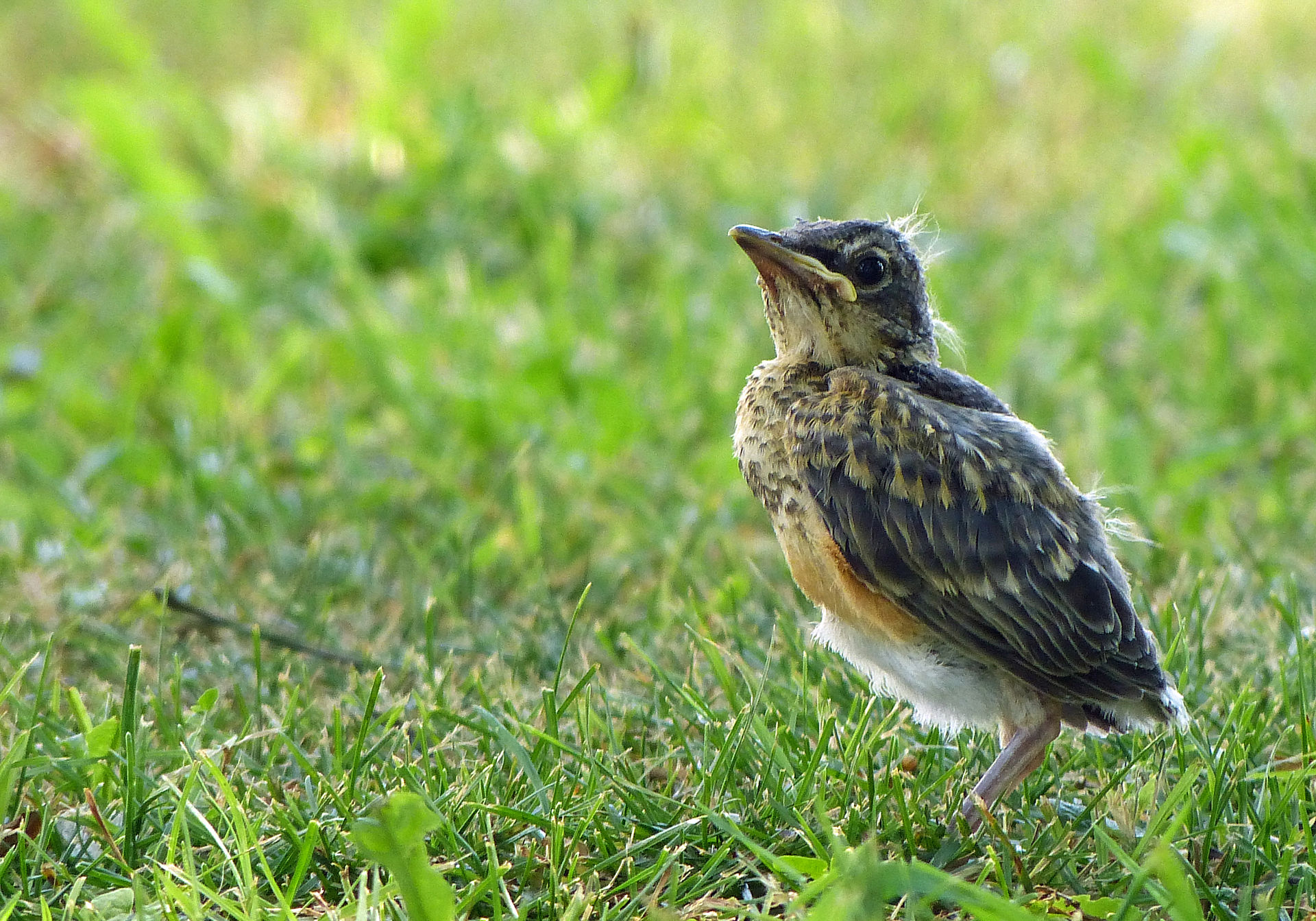
There are two main ways to identify a young bird, such as the robin pictured above: the beak and the tail (remember it as the two extremities - beak and tail). Baby songbirds have soft, yellow flaps of skin in the corner of their beak, sometimes called "bird lips". Also, they have very stubby tails, as their feathers are still growing in. There are other ways to tell, like stubby wings and left-over fuzz, but the extremities are the easiest to spot. 

Summer is not the most popular time to go birding, likely because birds are in 'stealth mode' so that predators can't find their nests or babies. Additionally, birds have already paired up, so there is no need to sing for a mate. It also just seems like birds don't care for heat!

Northern Rough-winged Swallow, a summer resident of The Woodlands. Photo by Toribird.

Northern Rough-winged Swallow, a summer resident of The Woodlands. Photo by Toribird.

Despite this, and in addition to seeing cute babies, migration is not far off! Shorebirds are one of the first migrant groups, beginning to travel around mid-August, but warblers, hawks, and others will soon follow. Migration is always an exiting part of the birding year, so definitely check out some local birding spots in the next month. While shorebirds are rarely seen from The Woodlands, due to our lack of, well, shore, they are easy to see on the mudflats of John Heinz, a wildlife refuge near the Philadelphia Airport. Also, the Woodlands is a great place for warblers, and you should be able to catch a migrating hawk or two as well. 


Written by Toribird

Birding at The Woodlands: A BRAND NEW ZINE & Early Summer Birding

Welcome to the first edition of our "Birding at The Woodlands" blog series! Resident birding expert, "Toribird" will be reporting on recent birding news happening at The Woodlands over the next few months. Stay tuned for updates all things zines, birds, and of course, TORIBIRD!


Zine_Buttons_5.22.2018.jpg

 I (Victoria, "Toribird") have spent the last couple months working on a zine-guide to birds of The Woodlands. I got my start here when Jessica Baumert and I teamed up to catch an escaped parakeet. During the hours-long process, Jessica realized that I love birds and birding, and I was offered an internship at The Woodlands. 

Toribird (left) with zine illustrator Jess Ruggiero (right) at the Zine Release Party.

Toribird (left) with zine illustrator Jess Ruggiero (right) at the Zine Release Party.

The zine was one of a few birding projects that I have worked on here. We began with birding tips shared on our blog. Then, I led two bird walks and taught how to make pinecone-bird feeders on Halloween Family Fun Day. I also led a lantern-lit walk on the Winter Solstice. 

Just recently, on the evening of May 22nd, my zine had its launch party. The illustrator, Jess Ruggiero attended, and I really enjoyed getting to meet her! As part of the festivities, I led two bird walks. Jess went along for one, and she seemed very exited to see the birds that she had spent so much time drawing; I liked sharing them with her.

Despite rain threatening, a nice group showed up.  They were an interested, supportive, group and a pleasure to lead on the walks! All in all, I had lots of fun chatting and sharing what I knew, and I think all our visitors had fun too!

If you're interested in purchasing a copy of the Guide to Birding at The Woodlands Zine, you can pick one up for $5 at an upcoming Woodlands Event. You can also donate $5 to The Woodlands and have a copy mailed to you. Donations can be made here.


Walks and parties aside, let's have a look at what's going on bird-wise at the Woodlands right now:

Spring migration is pretty much over. However, this means that each and every one of our summer residents are here. Some examples of birds that have returned are Ruby-throated Hummingbird, Northern Rough-winged Swallow, Grey Catbird, Yellow Warbler, and Chipping Sparrow. These birds are all common at The Woodlands during the warmer months of the year. See if you can spot them! 

Additionally, many songbirds are building nests and laying eggs right now. If you see a bird carrying rope, mud, grass, or other materials, you can know that it is busy constructing a cozy nest. Follow it and try to find their nest! Also, several birds are singing to attract a mate and defend their territory, though not as many as earlier in the year. Soon, you will be able to see this year's hatchlings. 

Here is a list of birds that are easy to see at the Woodlands right now:

American Robin resting its wings on a headstone at The Woodlands. Photo by Toribird. 

American Robin resting its wings on a headstone at The Woodlands. Photo by Toribird. 

  • Ring-billed Gull - look for them near the river

  • Mourning Dove

  • Chimney Swift 

  • Northern Flicker - A woodpecker, though that is not in its name

  • Eastern Kingbird - They seem to like sitting on top of headstones and catching bugs from there 

  • Northern Rough-winged Swallow

  • American Robin 

  • Grey Catbird - A well-named bird, as it is grey with a call that sounds like a nasal 'meow'

  • European Starling - An invasive bird introduced from Europe

  • Chipping Sparrow

  • Baltimore Oriole

  • Brown-headed Cowbird - A brood parasite, laying its eggs in other birds' nests


Looking for even more birding fun? Find out which type of bird YOU are based on your personality with my quiz. You can take the quiz here.  

Written by: Victoria Sindlinger

William Bartram's Travels and the Early Naturalist's Library

By Joel Fry

William Bartram's reputation as a botanist, naturalist, and explorer has endured in the modern world largely due to his single, classic book: Travels through North & South Carolina, Georgia, East & West Florida, the Cherokee Country, the Extensive Territories of the Muscogulges, or Creek Confederacy, and the Country of the Chactaws… Printed by James & Johnson, Philadelphia, 1791. William Hamilton had an extensive library and owned  at least two copies of the book authored by his friend. One of his copies is now housed at the Sterling Morton Library at the Morton Arboretum in Lisle, IL and offers an interesting glimpse into the naturalist's library.

A Map of the Coast of East Florida drawn by William Bartram for Travels. (Image: John Bowman Bartram Special Collections Library)

A Map of the Coast of East Florida drawn by William Bartram for Travels. (Image: John Bowman Bartram Special Collections Library)

In vivid text, Travels recounts Bartram’s southern explorations from 1773 to 1776, and documents his encounters with the natural world and with the native and colonial inhabitants of the English colonies along the Southern Atlantic and Gulf coasts. Bartram’s descriptions of Florida and the South captured readers internationally during his life and the book continues to be read widely in modern times. Bartram’s Travels was an unprecedented mix of literary genres—part travel book, part scientific record and description — a romantic narrative, an ethnography of Southern native peoples, and an exposition by Bartram on natural and theological philosophy.

The publication of Travels in Philadelphia in the 1790s was an expensive undertaking. A large book, running over 522 text pages with an additional introduction, the original edition included illustrations and a map by William Bartram. It took two subscription efforts to get the book to print, in what was a risky publishing effort in post-revolution Philadelphia. The first subscription effort for the book in 1786, by the Quaker printer Enoch Story, Jr. failed, perhaps for financial reasons, but also in part because William Bartram suffered a life-threatening fall and compound fracture at the ankle while gathering bald cypress seeds at Bartram’s Garden in fall 1786. It took over a year for Bartram to recover. A second broader national subscription for Travels in 1790 by the new firm of Joseph James & Benjamin Johnson in Philadelphia succeeding in seeing the book to print in summer 1791.

It has recently been discovered that Bartram’s Travels was issued in Philadelphia in more than one version. The standard version distributed to most subscribers had frontispiece, map and 7 illustrations. In early 1792 retail copies were also offered for sale with the option of “extra Plates, (eight in number)… either plain or coloured.” These extra plates were larger in size and were folded in thirds to be bound in the book. Currently only 5 sets of these extra illustrations are known.

James Trenchard engravings of two William Bartram drawings from the set of 8 rare extra plates:  “Bignonia Bracteata" (left) modernly known as Pinckneya or fevertree and “Franklinia alatamaha” (Image: American  Philosophical…

James Trenchard engravings of two William Bartram drawings from the set of 8 rare extra plates:  “Bignonia Bracteata" (left) modernly known as Pinckneya or fevertree and “Franklinia alatamaha” (Image: American  Philosophical Socitey Library)

It is not surprising that William Hamilton of The Woodlands seems to have owned at least two copies of the original Philadelphia edition of Bartram’s Travels. “The Woodlands Household Accounts” record payment September 8, 1792: “Bartrams Travels 11 [shillings]   3 [pence]”

Travels as advertised in Dobson and Claypoole's Daily Advertiser, January 4, 1792. (Image courtesy of Jim Green of the Library Company of Philadelphia

Travels as advertised in Dobson and Claypoole's Daily Advertiser, January 4, 1792. (Image courtesy of Jim Green of the Library Company of Philadelphia

This is the equivalent of the $2.00 price for a bound copy of William Bartram’s Travels, but it isn’t known if Hamilton was a subscriber or if he purchased a retail copy in 1792. [Accounts were frequently paid long after the fact in the 18th century.]

So far no trace of this first Hamilton owned copy of Bartram’s Travels has surfaced. A second, fine copy of Travels, with the standard plates colored, and bound with the 8 extra plates colored was presented by William Bartram to William Hamilton in 1799. This presentation copy from 1799 is now owned by the Sterling Morton Library at the Morton Arboretum, Lisle, IL.

The Hamilton extra-illustrated copy of Travels, contains a rare copy of William Hamilton’s bookplate under the front cover, engraved with the Hamilton family arms and “W. Hamilton.” William Hamilton was certainly a collector of books, as well as plants, art, statuary and more. Recent research by Villanova students turned up a dozen volumes in Philadelphia area special collections libraries with the Hamilton bookplate or signature. But Hamilton likely owned dozens or even hundreds of volumes on botany, gardening and natural history. One book signed and with the W. Hamilton bookplate is now part of a collection of Bartram family books donated to the Historical Society of Pennsylvania in the 1890s by a Bartram descendant. That book. Thomas Martyn, The language of botany…, London: 1796 is a standard dictionary of botanic terms in English. It was probably loaned to William Bartram or another Bartram family member and never returned to Hamilton.

William Hamilton's bookplate, engraved with the Hamilton family arms and “W. Hamilton," graces the inside cover of the copy of Travels held at Morton Arboretum. (Image courtesy of the Sterling Morton Library)

William Hamilton's bookplate, engraved with the Hamilton family arms and “W. Hamilton," graces the inside cover of the copy of Travels held at Morton Arboretum. (Image courtesy of the Sterling Morton Library)

The title page is signed by Hamilton on the upper right; “W. Hamilton’s Book give to him by the Author, June 9th, 1799.” No other documentation about this gift from William Bartram to William Hamilton survives. It may be Hamilton had lost or loaned his original copy of Travels, or he may have wanted an additional copy with the rare extra engraved plates?

It is clear that William Hamilton closely read this copy of Travels, as there are small annotations on several pages – including the addition of the scientific names “Gordonia Franklini” and “Pinckneya” on page 16, where the description of Franklinia was printed facing the two folded extra-illustrations of “Franklinia alatamaha” and “Bignonia bracteata” [modern Pinckneya bracteata, or fevertree].

"W. Hamilton's Book given to him by the Author June 9th, 1799" is inscribed on the cover page. (Image courtesy of the Sterling Morton Library)

"W. Hamilton's Book given to him by the Author June 9th, 1799" is inscribed on the cover page. (Image courtesy of the Sterling Morton Library)

Other notes by Hamilton in his extra-illustrated copy of Travels also comment or annotate some of the rarest plants that William Bartram encountered in his trip. And of course there is evidence that Hamilton was growing some of William Bartram’s southern plant discoveries in the garden at The Woodlands. One of the seed packets recently recovered from the attic of The Woodlands was labeled “Hydrangea quercifolia, Bartram’s Travels” and oakleaf hydrangea was another new plant described and illustrated by Bartram in the book. 

Hamilton’s note of the scientific name “Gordonia Franklini” for Franklinia references part of a rare illustrated collection of new plants from Paris, published by the botanist Charles Louis L’Héritier de Brutelle in 1791. And the genus name Pinckney…

Hamilton’s note of the scientific name “Gordonia Franklini” for Franklinia references part of a rare illustrated collection of new plants from Paris, published by the botanist Charles Louis L’Héritier de Brutelle in 1791. And the genus name Pinckney was not published as a scientific name until 1803 by the French botanist André Michaux. Hamilton may have learned of both these then current scientific names from Michaux’s Flora.  Note the Franklinia plate folded to the right (as shown in the image above). (Image courtesy of the Sterling Morton Library)

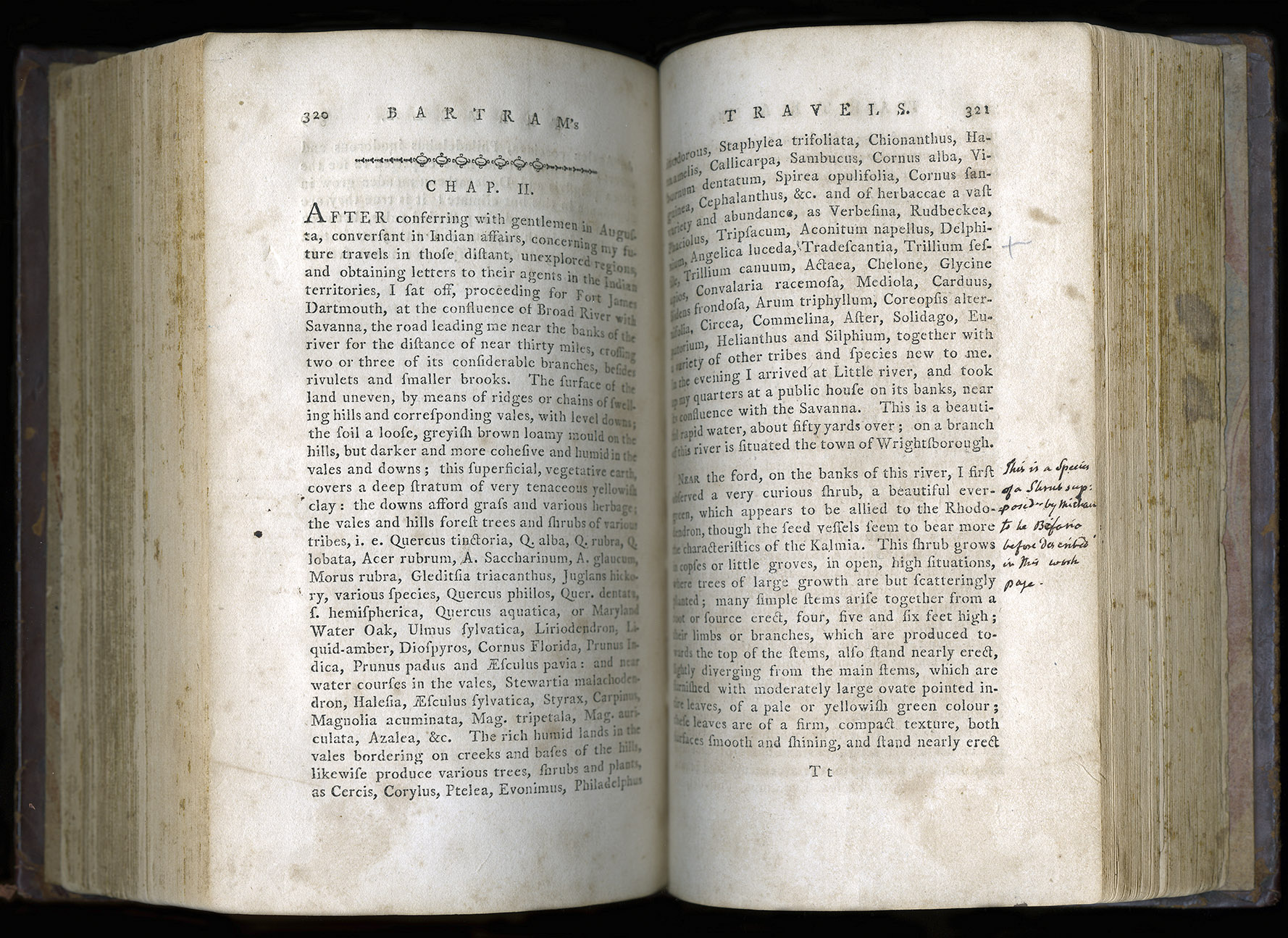
A note by Hamilton reads, "“This is a Species of a Shrub supposed by Michaux to be Befaria before described in this work page —.” Interestingly, this plant has gone through three spellings, “Befaria”, “Besaria”, and “Bejaria”. It is now officially c…

A note by Hamilton reads, "“This is a Species of a Shrub supposed by Michaux to be Befaria before described in this work page —.” Interestingly, this plant has gone through three spellings, “Befaria”, “Besaria”, and “Bejaria”. It is now officially called Bejaria racemosa, flyweed, a flowering shrub from Florida discovered by William Bartram. Flyweed as “Befaria hirsuta” was listed for sale as a greenhouse plant in Bartram Catalogues from 1807 onward. (Image courtesy of the Sterling Morton Library)

Hamilton's inscriptions are telling; he only made notations in the botanic sections of Travels, indicating little interest  in sections dealing with birds and wildlife, or in the parts dealing with Native peoples — the Creek, Seminole, and Cherokee.

Handwritten “Errata” by William Bartram, slipped in at the end of Hamilton's copy of the book. (Image courtesy of the Sterling Morton Library)

Handwritten “Errata” by William Bartram, slipped in at the end of Hamilton's copy of the book. (Image courtesy of the Sterling Morton Library)

A group of  scholars, including Nancy Hoffmann, Bill Cahill, Alina Josan and Joel Fry, are currently working to research and locate copies of the 1791 edition of William Bartram’s Travels, collating a census of copies, and looking for owner’s names, annotations, binding, and general history. The researchers have located over 125 copies, mainly in special collections libraries in the US, and have visited 56 or more copies. Many or most of the copies seem to be subscription copies, and a third or more have a similar original binding. Many of the owners who signed copies were substantial citizens in the early U.S, and local lending libraries around Philadelphia also held a number of copies. Only four are now known bound with the extra plates seen in William Hamilton’s copy at the Morton Arboretum. As of yet, the researchers don’t have a firm knowledge of how many copies of the 1791 Philadelphia edition were printed, but they estimate that it might be on the order of 400 or 500 total. 

The lasting fame of Travels is probably due to the widespread European reprints of the book, which began to appear in 1792, a year after the Philadelphia printing. There were English editions of Travels in London in 1792 and 1794, Dublin: 1793; translations into German with editions in Berlin and Vienna: 1793; a Dutch translated edition in Haarlem, 1794-1797; and French translated editions from Paris: 1799 and 1801. These European editions were all based on the 1791 subscription version and copied the standard illustrations, but never included the 8 extra plates.

Stay tuned as we highlight more of the fascinating botanical connections between these two sites!

Previous Posts: 
Introducing the Two Williams
Found in the Floorboards: 200 Year Old Seed Packets

Upcoming Posts: 
Think Local Swap Global: 18th Century Approaches to Plant Collecting
From Seed Shack to Plant Palace: Evolutions in Greenhouse Technologies
The 19th Century Commercial Nursery

The House in the Cemetery: Podcasting History

Mansion_Image_South.jpg

“Why did someone build a house in the cemetery?” It’s a question I’ve heard more than once as I’ve volunteered at a Woodlands event or walked through the cemetery with friends. When it came time for me to teach a public history practicum for graduate students in History at Villanova University, I decided to use this common misreading of the landscape as a starting point. The cemetery was, in fact, created in 1840 to preserve the estate of William Hamilton as green space in urbanizing West Philadelphia. I charged my students with designing and executing a class project that would make the eighteenth-century history of the site legible to listeners who frequent the site and to ones who might never visit.

To guide them, I took inspiration from a woman I had met at The Woodlands back in 2014: Dr. Liz Covart. She attended a tour that I co-lead with Aaron Wunsch for historians of the early United States and introduced herself by saying that she was starting a history podcast. Three years later, Ben Franklin’s World has become a runaway successful with well over 3 million downloads, nearly 200 episodes, and numerous sponsors. (Thanks to that tour, Episode 11 of Ben Franklin’s World features Jessica Baumert, Executive Director discussing the The Woodlands!)

So in January of this year, my students set out to design, research, write, and produce a podcast series that explored the history of The Woodlands before it became a cemetery. In the first three weeks of class, we laid the intellectual groundwork for three key components of our project. First, we read published scholarship and unpublished research files about the Hamilton family and The Woodlands to orient ourselves in site-specific histories. Second, we read scholarship about doing history with, and for, public audiences. We also assessed The Woodlands master plan and met with Jessica Baumert to discuss her leadership goals and current uses of the site. Third, we studied the elements of Dr. Covart’s podcast episodes and dipped into ongoing conversations about how podcasting can be good scholarship. Best of all, Dr. Covart joined us on campus for a workshop!

And then: we became podcasters. Each student wrote and produced an episode. But we worked as a team to write a single intro, select and edit music, and build a shared architecture for each episode – including the segment “Primary Exposure,” which focuses on how historians use evidence to analyze the past. It quickly became clear in defining these elements that we wanted to share the process of doing history with our listeners just as much as we wanted to share knowledge about The Woodlands.

To that end, we hope that listeners enjoy hearing about the people who lived and worked at The Woodlands when it was an estate. But we also hope that the episodes expose how historians think and reveal some of the principles that guided us in creating them:

1. A good podcast depends on good history. Right after students submitted their final sound files, one student said, “I hope listeners don’t think we just turned on the microphone and started talking.” I assured him that their podcasts gave listeners plenty of clues to the depth of work that went into the final product. Each student wrote a podcast script that upholds academic standards of evidence, analysis, and citation. Students worked with peers and with me to edit these scripts heavily before recording. Without good content, all of the work of recording and audio editing would be meaningless.

2. Good history depends on collaboration. We did not do this project alone. Our podcast website thanks a number of people who provided support specifically for the recording of our podcasts. Yet our research also built on work done by previous researchers, historians, architectural scholars, and archaeologists. Podcasters walked a fine line as they worked to keep podcasts listenable while also crediting the work of the scholars that they engaged. Links to key books and documents in each episode’s show notes include only a few sources that informed the podcasts. We hope that our work can be a resource for future work as well.

3. Good history participates in ongoing conversations. Historians working in public and academia hold this as a core value. We aimed to design podcasts informed not only by our perspectives as historians but also by our assessment of The Woodlands’ strategic plan, the activities of current users, and issues that might interest neighborhood residents not yet engaged with The Woodlands. We also felt that it was important to get listener feedback at public events and online to think about how to improve the podcasts and select topics for future programs and historic research.

I am very proud of the work that these students have done this semester, and we are all very excited to share it with you. We welcome your feedback at our public event on Wed., April 25, 5:30-7:30 p.m., at the Go West Craft Fest on Sat., Apr. 28., or as a comment on this blog post. Happy listening!

About the author: Dr. Whitney Martinko is an assistant professor of History at Villanova University. She lives in the Cedar Park neighborhood of West Philly and has volunteered at The Woodlands since 2013.

Found in the Floorboards: 200 Year Old Seed Packets

Did you know that William Hamilton of The Woodlands and William Bartram of Bartram's Garden were contemporaries and friends? The two shared a love of plant collecting and botany, were neighbors, and were involved in many of the same local institutions! To highlight some of these lesser-known connections, we're bringing you Two Williams: a six month blog series hosted between The Woodlands and Bartram's Garden. Each month, we will dig into the archives and share what we find!

The attic, or garret, of The Woodlands Mansion. Photo: Starr Herr-Cardillo

The attic, or garret, of The Woodlands Mansion. Photo: Starr Herr-Cardillo

Uncommon for someone of his wealth and status, William Hamilton of The Woodlands left relatively little evidence of his life behind. Unlike William Bartram, who devotedly documented his work (in elegant prose, no less!) much of what we know about Hamilton’s plant collection and the design of his estate is through a small selection of personal letters and visitor accounts. With no direct heirs, most of Hamilton’s personal effects, art, and furniture collection were gradually dispersed with the estate. Today, the few known collections of personal letters and accounts are located in various repositories and archives around Philadelphia. Though this means that researching Hamilton can be a challenge, it also makes new discoveries more exciting because you never know where or when you might find them. Thanks to a hungry group of rodents and a meticulous historian, an unexpected discovery was made in the attic of The Woodlands that revealed quite a bit about Hamilton’s plant collection.

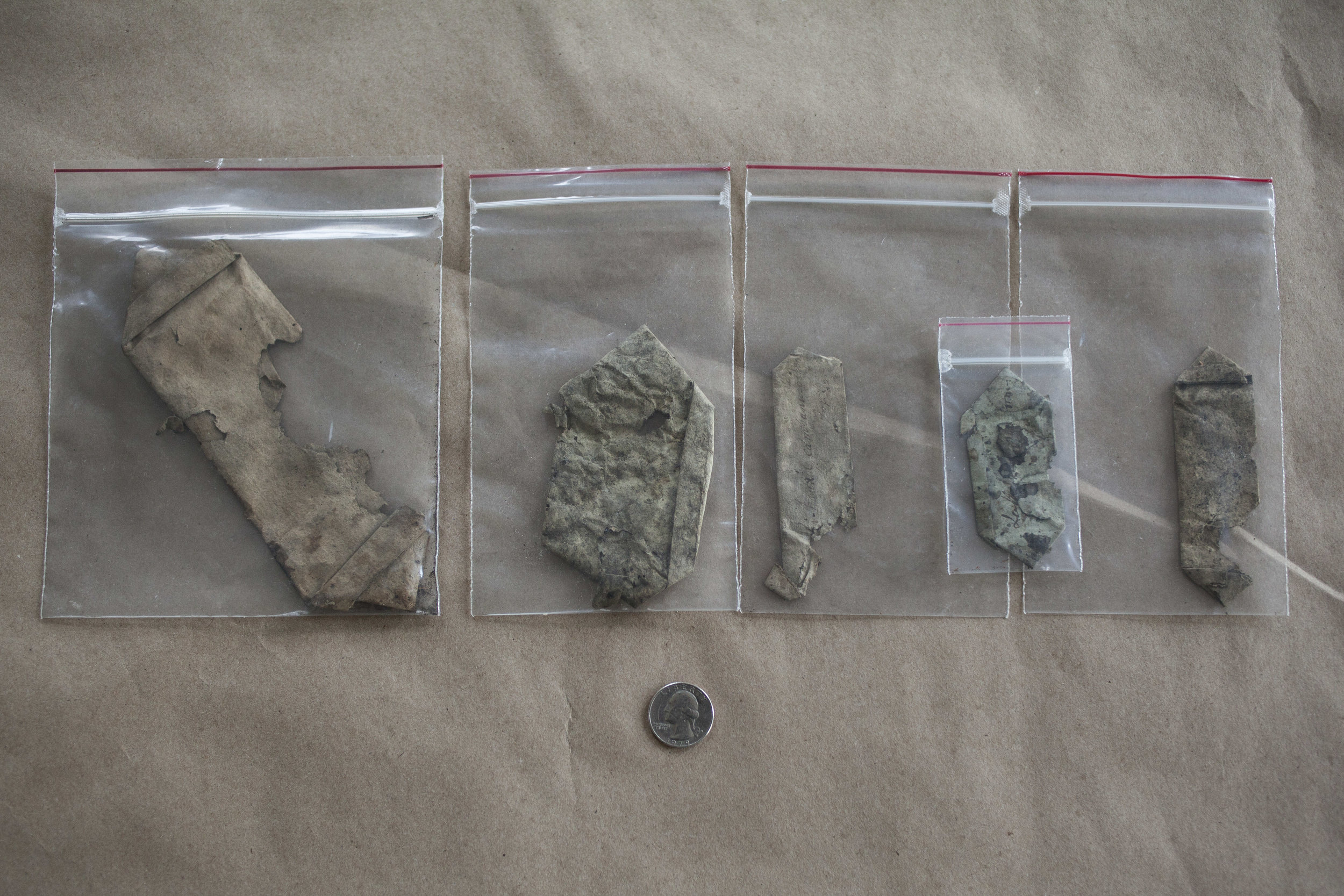
In the early 1990’s, as architectural historian Tim Long poked around some of the unfinished sections of the attic while examining the framing structure of The Woodlands mansion, he noticed small terra cotta fragments strewn throughout, which he as able to identify as bits of small, hand-thrown starter pots used to sprout seeds. With a more discerning eye, he reexamined the floor and began to make out the edges of dozens of rectangular pieces of paper, caked beneath a thick layer of dust, resting between the floor joists. After carefully gathering some samples, Long identified the flimsy objects as historic seed packets, based on similar ones he had seen on display years earlier at Bartram’s Garden. These once ubiquitous, hand-folded packets were generally 6-sided and distinguished by a self-locking folding technique, which produces triangular ends. Long collected the packets and they were eventually placed on loan in the botany department of The Academy of Natural Sciences for safekeeping and to allow for further study.

The seed packets were discovered between joists in the attic floor. Photo: Starr Herr-Cardillo

The seed packets were discovered between joists in the attic floor. Photo: Starr Herr-Cardillo

The folded packets were created from a variety of papers in a variety of sizes, and were carefully inscribed in cursive with Linnaean binomials. Some packets also included botanical authorities, along with dates or personalized notes related to their contents. As Bartram’s Garden Curator Joel Fry, who analyzed and catalogued all 250+ examples says, this was a “rodent-selected sample,” which probably means that hungry critters were pulling packets with edible or tasty seeds from a box or boxes left in the attic for storage. Consequently, most of the packets and their contents had been liberally gnawed, making the labels a little more challenging to decipher. In 2007, Fry transcribed and catalogued the collection, translating the historic plant names from the packets into modern scientific binomials, transcribing notes, and where possible identifying the label writers.

The majority of the packets were written by an unidentified writer, which Fry suspects may have been a professional clerk or scribe, due to the stylized nature of the handwriting and apparent skill of the calligraphy. He notes that the handwriting differs from the typical style of writing common in Philadelphia around 1800. Packets inscribed by “the X writer” (so-named by Fry because of the way the writer’s r’s resembled the letter x) may have originated somewhere in Europe, or were at least inscribed by a writer trained there.

William Hamilton labeled a third of the collection himself (87 packets), a detail that Fry believes speaks to his proficiency in botanical science—it would have been rare at that time for people to know the correct scientific names for such a wide variety of plants. As Fry points out: if you were to randomly select people off the street today, how many could come up with the Latin names for any plant, let alone dozens of them? Hamilton even went as far as to supply multiple Latin names on a few of the packets, a detail that Fry says indicates he was privy to contemporary controversies in plant naming conventions. A handful of packets appear to be labeled by different unidentified writers. At least one packet was labeled by neighbor William Bartram. Some of the species represented in the collection were North American native species that the Bartrams first collected and grew, which William Hamilton likely acquired from William Bartram and the Bartram family garden.

Fragments of small, hand-thrown terra cotta pots used for starting seeds were also found. Photo: Starr Herr-Cardillo

Fragments of small, hand-thrown terra cotta pots used for starting seeds were also found. Photo: Starr Herr-Cardillo

The distinctive folding style is particularly visible on this large seed packet. Photo: Starr Herr-Cardillo

The distinctive folding style is particularly visible on this large seed packet. Photo: Starr Herr-Cardillo

The packets were various sizes and made from different types of paper. Photo: Starr Herr-Cardillo

The packets were various sizes and made from different types of paper. Photo: Starr Herr-Cardillo

Each has been inscribed, though some are difficult to decipher due to missing fragments from rodent damage. Photo: Starr Herr-Cardillo

Each has been inscribed, though some are difficult to decipher due to missing fragments from rodent damage. Photo: Starr Herr-Cardillo

The collection of plants represented by the packets consists of a wide-ranging mix of plant species and types. Comprised mostly of relatively small seeds, the collection is skewed towards herbaceous plants — non-woody perennials, biennials, and annuals, but there were also some woody plants represented. Though there are some native plants in the collection, most of the plant species represented are exotics from a variety of provenances around the globe, which were also often denoted on the packets. The majority are considered to be outdoor plants—including edible varieties—and things that wouldn’t be uncommon to find in a kitchen or flower garden, as opposed to temperature-sensitive tropical greenhouse plants.

An expert historian like Fry can also read into some of the more specific details hidden within the collection. He points out that the abundance of hibiscus or mallow family plants (the Linnaean “Monadelphia Class” which included tea, cotton, okra, camellia, and the Bartrams’ Franklinia among others) indicates Hamilton was tuned in to important scientific developments and trends of the time. A prominent Spanish botanist, Antonio José Cavanilles (1745-1804), had been publishing a series of dissertations on this plant group at the end of the 18th century, and the “Monadelphia” were also the subject of significant research in Paris. The Woodlands seed packets include several “economic plants” imported from India, Asia, and Africa that align with the general interest of the time to import useful plants that could drive economic wealth. Both jute and dunchi fiber, which could be used for rope and cordage were found within the collection.

The packets also provide evidence that the plantings at The Woodlands were not without garden flowers, some which we now consider common (e.g. morning glories, marigold, zinnia, larkspur and yarrow); and some medicinal plants (e.g. euphorbia, monks rhubarb, nightshade and jimsonweed). The packets also included a number of garden vegetables, some of which would have been quite uncommon in the U.S. at the time, including seeds from two varieties of guava (which had to have winter shelter in a greenhouse), Thai basil, eggplant, several melons, and multiple varieties of cabbage.

According to Fry, three of the most historically significant plants found within the collection are:

Hydrangea macrophylla, a.k.a. French hydrangea or blue Hortensia, labeled by Hamilton as “Hydrangea mutabilis,” which he described as “a most beautiful flowered Shrub from China.”

Image courtesy of The Academy of Natural Sciences of Drexel University.

Image courtesy of The Academy of Natural Sciences of Drexel University.

Known today as the Hydrangea macrophylla, this plant is a garden favorite. The flowers can be pink or blue depending on the alkalinity of the soils they are grown in. Illustration published by Curtis in London in 1799.

Known today as the Hydrangea macrophylla, this plant is a garden favorite. The flowers can be pink or blue depending on the alkalinity of the soils they are grown in. Illustration published by Curtis in London in 1799.

This is the same variety of blue hydrangea that we know and love today, but was then a very rare shrub, sent to the UK from China around 1790, only a few years before Hamilton acquired it. Hamilton was very probably the first to introduce this plant to North America. In a letter written the summer of 1800, William Bartram mentions the new hydrangea in bloom at The Woodlands, describing the “Cœlestial blue of the flowers” as “Inexpressebly pleasing.” Fry notes that Hydrangea was a newly named plant genus that had only recently been discovered in the 18th century. In fact, John Bartram may have been the first to scientifically record a hydrangea in eastern North America when he discovered Hydrangea arborescens, the American wild hydrangea.

Hydrangea quercifolia, a.k.a. oakleaf hydrangea, also inscribed by William Hamilton, includes the note “Bartram’s Travels” at the bottom.

Image courtesy of The Academy of Natural Sciences of Drexel University.

Image courtesy of The Academy of Natural Sciences of Drexel University.

William Bartram’s illustration of Hydrangea quercifolia, engraved for the first edition of Travels, Philadelphia: 1791. Image from the collections of the John Bartram Association.

William Bartram’s illustration of Hydrangea quercifolia, engraved for the first edition of Travels, Philadelphia: 1791. Image from the collections of the John Bartram Association.

William Bartram named the species Hydrangea quercifolia and included an illustration in his book Travels, published in Philadelphia in 1791. The plant’s inclusion in The Woodlands collection is interesting; though oakleaf hydrangea is now a common household and garden shrub, at the time it was a very rare plant in gardens. When William Bartram illustrated and named the new hydrangea, he probably did not have a live example at Bartram’s Garden. Only in March 1791 did the French botanist and traveler André Michaux send live plants of oakleaf hydrangea from his South Carolina garden to the Bartrams in Philadelphia. It is likely that Hamilton’s plant also came from French botanist Michaux or from the Bartram plants shipped by Michaux.

Aeschynomene virginica, labeled phoenetically by Hamilton with its Latin name as “Eschinom: inundata” and the note “with articulated pods viscid[ula…]s Mic[haux] by George from Jersey 1803.”

Image courtesy of The Academy of Natural Sciences of Drexel University.

Image courtesy of The Academy of Natural Sciences of Drexel University.

Aeschynomene virginica or joint-vetch is an annual member of the legume family found on fresh-water tidal flats. Photo: Joel Fry

Aeschynomene virginica or joint-vetch is an annual member of the legume family found on fresh-water tidal flats. Photo: Joel Fry

This plant, a sensitive joint-vetch, was once a common native of the fresh-water tidal marshes of the lower Schuylkill and Delaware Rivers, though it had been virtually eradicated in Pennsylvania and today can only be found in a few protected marshes in southern New Jersey. William Bartram was aware that this was a rare species and had discussed it letters, noting that it had formerly grown in marshes along the Schuylkill with wild rice and other wetland species. Hamilton’s note is of particular interest in this case, since it seems to indicate that the seeds were collected by George Hilton, Hamilton’s African American gardener who was sent to southern New Jersey to collect them, precisely the place where the plant can still be found. There is some evidence that William Hamilton also sent George Hilton on a collecting trip to the southwest corner of Pennsylvania to collect new native plants.

Shortly following the discovery of the seed packets, Fry and his colleague Robert M. Peck, Senior Fellow of The Academy of Natural Sciences co-authored an article detailing the discovery of the collection of seed packets and its significance. Though submitted for review, the article has yet to be published, perhaps in part due to the general lack of appreciation and understanding of Hamilton’s contributions to early U.S. botanical study. They plan to persevere and re-submit to a different publication in the near future. The collection of seed packets is now safely housed in the rodent-free herbarium at the Academy of Natural Sciences of Drexel University, which is probably for the best, though we should pause and appreciate the critters in the attic of The Woodlands for their assistance in making a major historical discovery, which without their hoarding antics might never be known.

By Starr Herr-Cardillo with contributions by Joel Fry


Want to save your seeds like an 18th century botanist? Follow these instructions and channel William Hamilton and William Bartram!

seed packet fold.jpg

Stay tuned as we highlight more of the fascinating botanical connections between these two sites!

Previous Posts: 
Introducing the Two Williams

Upcoming Posts: 
William Bartram's Travels and the Early Naturalist's Library
Think Local Swap Global: 18th Century Approaches to Plant Collecting
From Seed Shack to Plant Palace: Evolutions in Greenhouse Technologies
The 19th Century Commercial Nursery


This blog series is made possible by Penn Sustainability and PennDesign.